Fractional CFO vs Full-Time CFO: Real Costs & Decision Guide (2026)
Fractional CFO vs full-time: real 2026 cost ranges, when each model fits, and the hybrid structure most growing companies overlook.

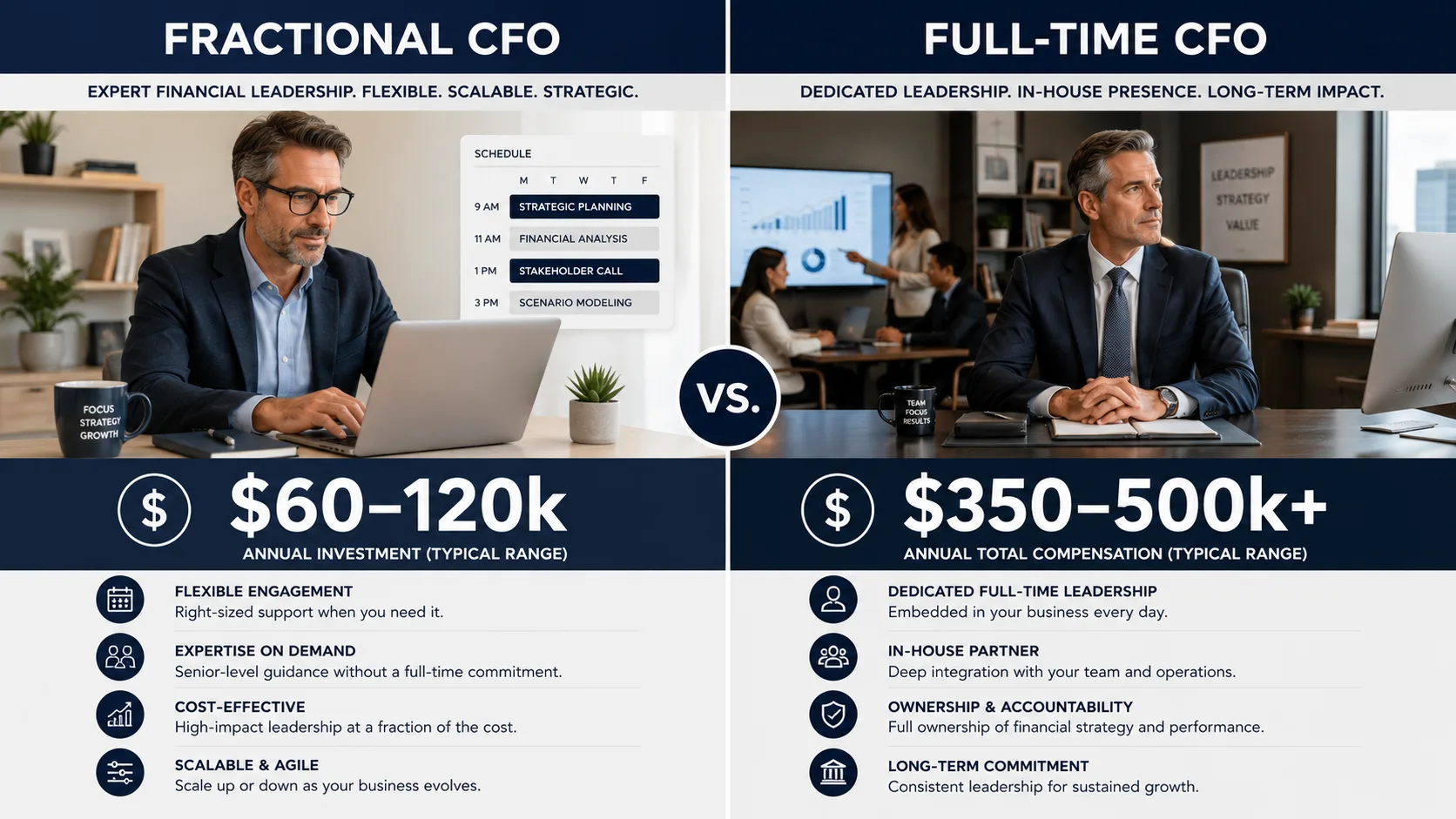
Most growing companies eventually hit the same inflection point: the fractional CFO vs full-time CFO decision.
You have outgrown basic bookkeeping. Your controller (if you have one) is buried in the close. Leadership needs better cash visibility, forward-looking insight, and someone who can challenge the numbers before decisions are made. At the same time, the fully loaded cost of a full-time CFO, often $350,000 to $500,000+ once salary, benefits, bonus, equity, and recruiting are included, feels difficult to justify.
This is the exact gap the fractional CFO advisory model was designed to solve.
This guide provides a clear, practical comparison so you can decide with confidence. It covers real cost ranges, what each model actually delivers, when each makes sense, the hybrid structure many companies overlook, and a decision framework you can apply immediately. For local price bands, see our published Fractional CFO in Rockford, IL cost guide.
Key takeaways
- A fractional CFO typically costs about 20 to 30 percent of a fully loaded full-time CFO hire while covering most strategic finance needs for $3M to $25M companies.
- Full-time becomes clearer when complexity, finance-team leadership, and daily decision volume truly need 40+ hours of CFO capacity every week.
- Many organizations win with a hybrid: fractional CFO for judgment plus an internal controller for the close.
- In our experience leading finance transformations and fractional CFO engagements, the wrong hire is usually "too much fixed cost too early," not "too little title."
1. The Real Cost of Each Model
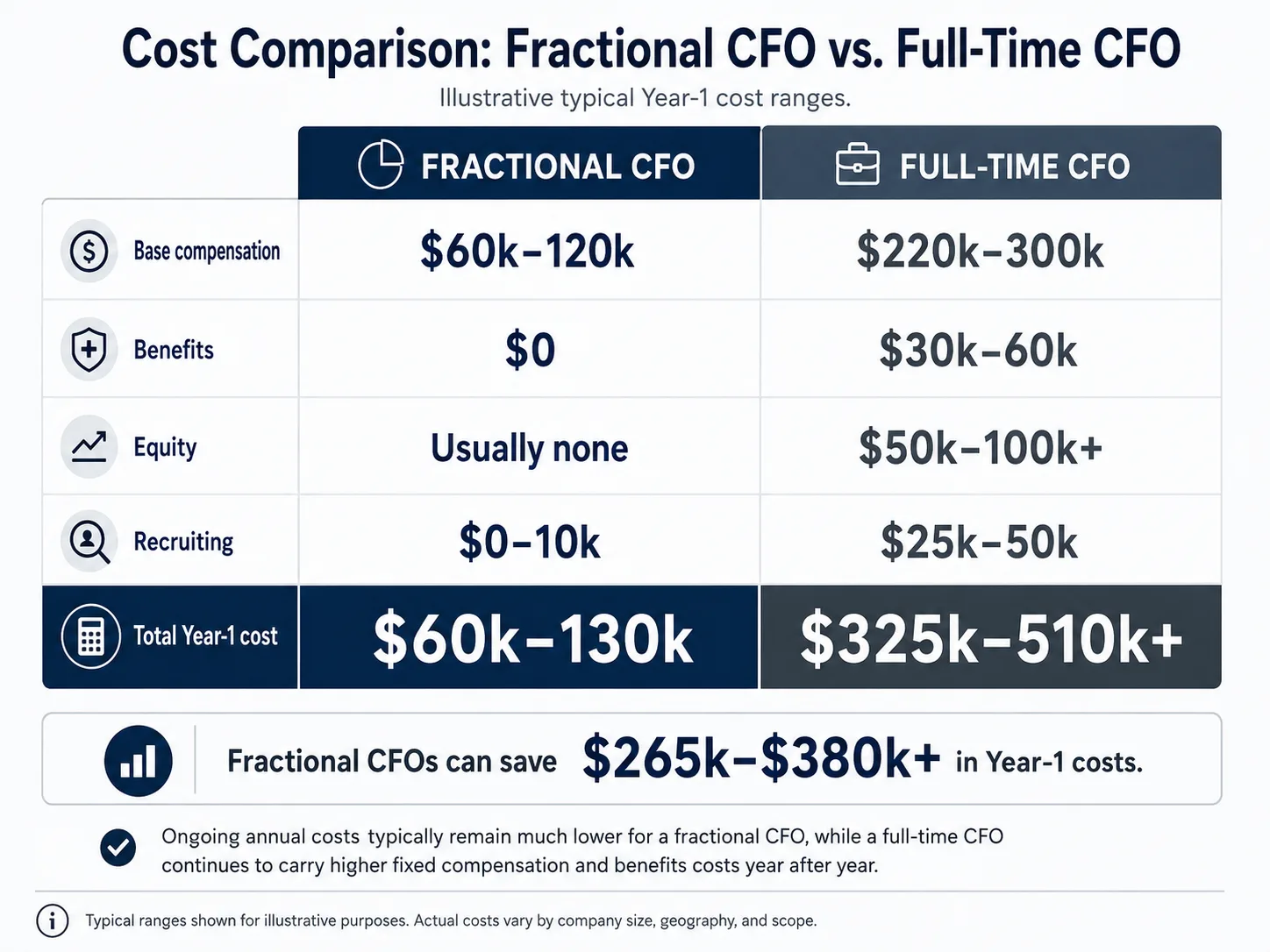
Cost Component |
Fractional CFO |
Full-Time CFO |
|---|---|---|
Base compensation / retainer |
$60,000 to $120,000 |
$250,000 to $350,000 |
Benefits and payroll taxes |
$0 |
$50,000 to $90,000 |
Bonus / equity value |
$0 |
$30,000 to $120,000+ |
Recruiting and onboarding (Year 1) |
$0 |
$40,000 to $90,000 |
Typical Total Year 1 Cost |
$60,000 to $120,000 |
$370,000 to $650,000+ |
Ongoing annual cost (Year 2+) |
$60,000 to $120,000 |
$330,000 to $550,000+ |
These ranges reflect real mid-market engagements as of 2026. Wage data helps explain the base of the full-time column: the U.S. Bureau of Labor Statistics reports a median annual wage of $161,700 for financial managers (May 2024). CFOs sit at the top of that ladder, so cash salary is only the start. Benefits, employer payroll taxes, bonus, equity, and recruiting push all-in cost far above the median wage. The IRS overview of employment taxes is a useful reminder that employer-side taxes and compliance are real cash costs of a W-2 hire, not abstract accounting entries.
Actual numbers vary by company size, complexity, industry, and geography, but the structural gap remains consistent: a fractional CFO typically costs 20 to 30% of a full-time hire while delivering the majority of the strategic value most growing companies need. For Northern Illinois rate context, compare against our Rockford fractional CFO cost guide.
Hidden costs of a full-time hire that are often underestimated include longer ramp time (commonly 3 to 6 months before full productivity), severance risk if the hire does not work out, and the opportunity cost of locking significant cash into a fixed leadership seat before the business truly requires it.
2. What Each Model Actually Delivers
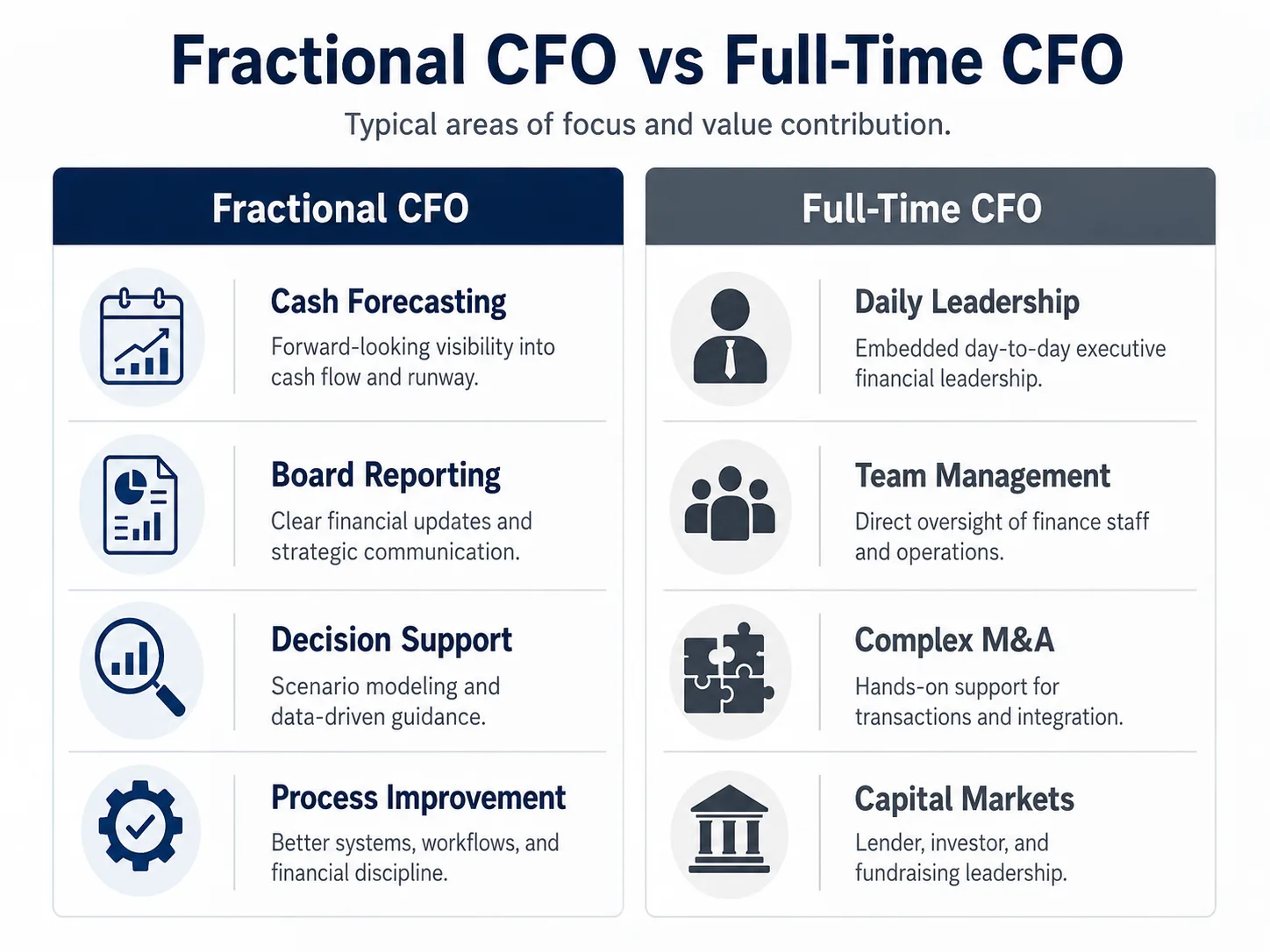
A capable fractional CFO typically focuses on:
Building and maintaining a 13-week rolling cash flow forecast
Creating decision-ready monthly and board reporting packages
Analyzing pricing, margins, and unit economics
Running scenarios that support major decisions
Identifying process and systems gaps (often the bridge into process optimization or ERP work)
Supporting banking relationships, fundraising, or exit preparation
Providing experienced perspective from having worked across multiple companies
A full-time CFO adds:
Daily presence and immediate availability
Direct leadership and development of the finance team
Deeper ownership of the entire finance operating rhythm
Capacity for complex, ongoing capital markets or multi-entity M&A work
Stronger cultural integration into the senior leadership team
The difference is less about intellectual quality and more about hours available and organizational depth. Credential and competency still matter on both paths. Programs such as the AICPA & CIMA CGMA Finance Leadership Program describe the breadth of finance leadership skill (planning, performance, and decision support) that you should expect from either a fractional or full-time CFO, not from a bookkeeper or close-only controller.
Many companies do not need 40+ hours of CFO-level time every week. They need high-quality judgment applied to the right problems on a consistent cadence. If the gap is broader than one role, our guide on why healthcare organizations need financial leadership walks through the same leadership ladder from bookkeeping through controller to CFO-level work.
3. When a Fractional CFO Is the Clearer Choice
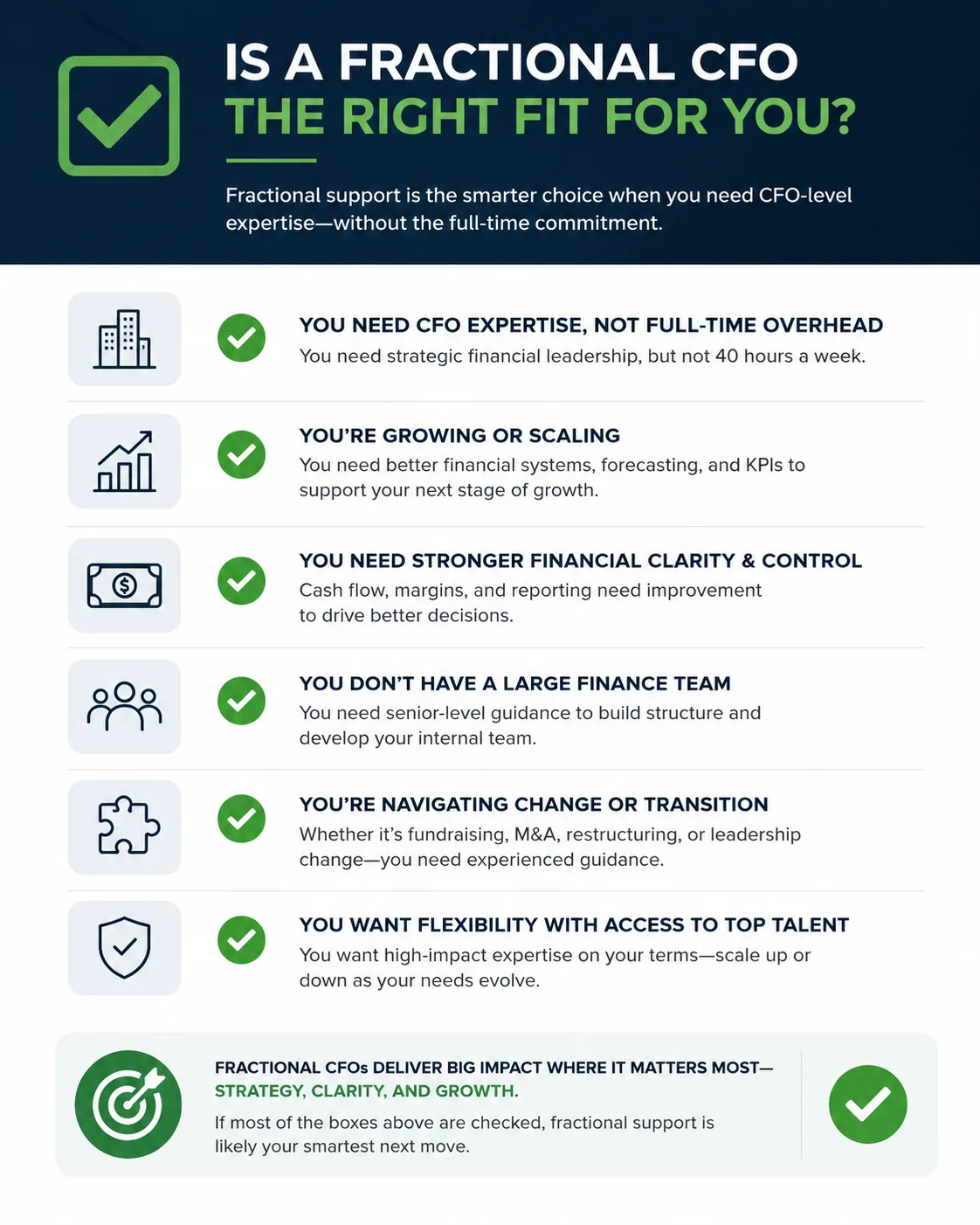
Fractional support is usually the stronger fit when most of the following are true:
Annual revenue is roughly $3M to $25M
The primary gaps are cash visibility, forecasting quality, and strategic decision support
You do not yet need (or cannot fully utilize) 40 hours per week of CFO time
You want pattern recognition from someone who has seen similar problems across multiple companies
You prefer lower fixed cost and the ability to adjust scope as the business evolves
You are not under immediate pressure from a board or investors to have a full-time internal CFO
This profile describes the majority of companies we work with. In these situations, forcing a full-time hire often creates unnecessary fixed cost without a proportional increase in decision quality. Healthcare operators facing payer-mix, denial, and multi-site pressure often land in this zone first; the operational finance story is the same whether you frame it as healthcare finance transformation or as a pure headcount decision.
If you are still building basic financial hygiene, the U.S. Small Business Administration's guide to managing your business finances is a solid free baseline before you buy CFO hours. Fractional work pays off once you already generate enough volume and complexity that senior judgment moves cash, margin, or capital outcomes.
4. When a Full-Time CFO Becomes the Better Path
Move toward a full-time CFO when several of these conditions are present:
Revenue is consistently above $25M to $30M with meaningful operational complexity
You already have a finance team that requires daily leadership and development
You are preparing for significant M&A, IPO, or complex capital markets activity
The board or investors explicitly require a full-time internal CFO
The volume of high-stakes decisions genuinely requires near-daily senior finance involvement
Even in these cases, many companies still benefit from fractional support during the transition period or as a supplement while the full-time hire ramps. BLS also notes that employment of financial managers is projected to grow much faster than average over the next decade (see the same Financial Managers outlook), which is one reason recruiting a strong full-time CFO can take longer and cost more than owners expect.
5. The Hybrid Model Most Companies Overlook
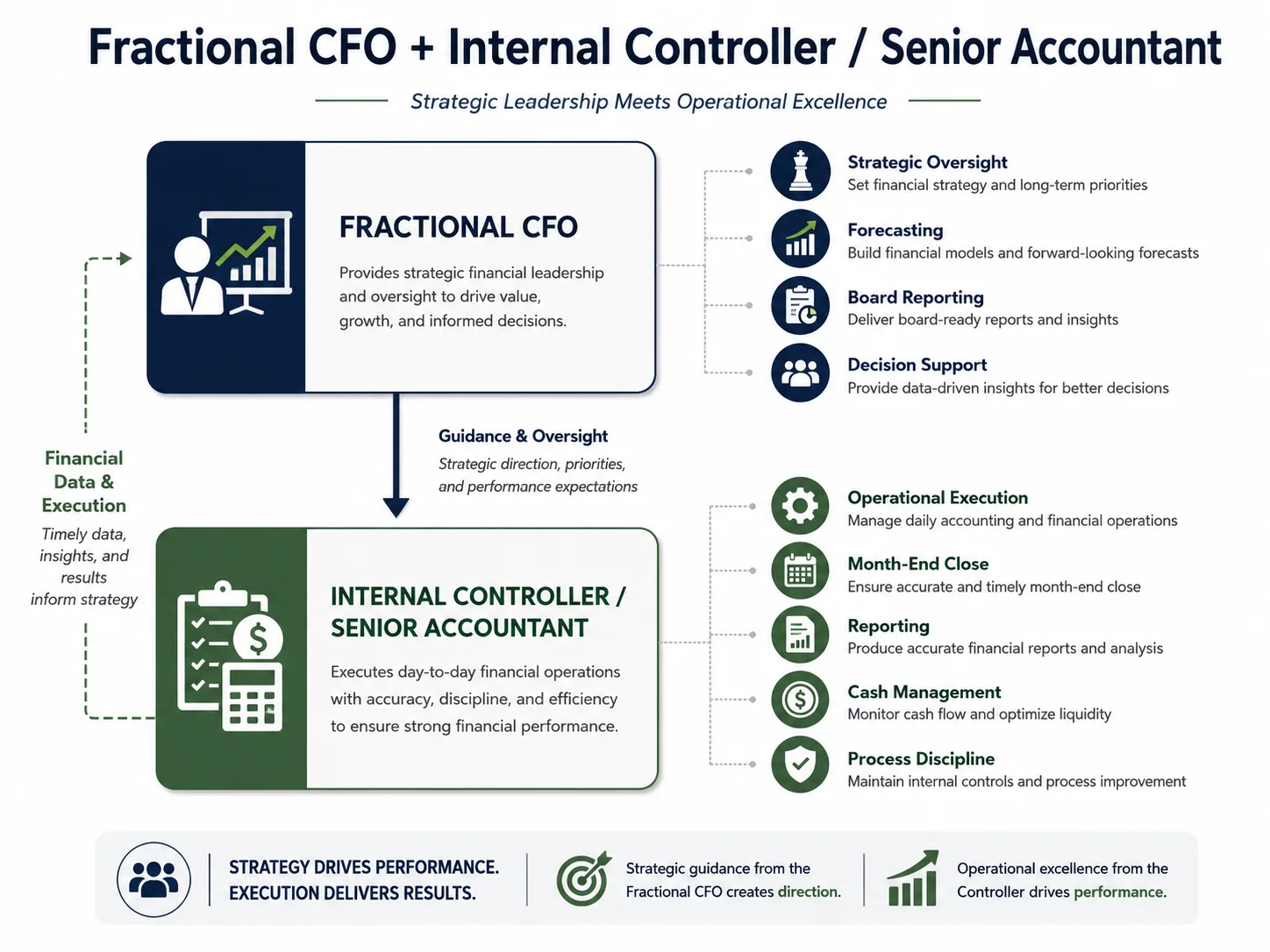
One of the highest-ROI structures we regularly implement is:
Fractional CFO + capable internal controller or senior accountant
In this model the fractional CFO owns forward-looking insight, cash discipline, reporting quality, and decision support. The internal resource owns the daily accounting engine and the monthly close. The combination usually delivers better results than either forcing a premature full-time CFO hire or continuing to operate with only transactional finance support.
This structure is particularly effective in the $5M to $20M revenue range. It also depends on a solid accounting foundation. If the books, close, or reporting stack are weak, fix that layer first. Our healthcare accounting services guide covers what "good enough" monthly accounting looks like before you buy CFO capacity. When the bottleneck is workflow rather than headcount, pair the hybrid model with process optimization or, when systems are the constraint, ERP implementation.
6. A Practical Decision Framework
Work through these four questions with your leadership team:
How many hours per week of true CFO-level work do we actually need right now?
Is our biggest current gap strategic insight and cash visibility, or day-to-day finance operations?
Can we comfortably commit $350k to $500k+ of fixed annual cost for the next several years?
Do we need someone who has already solved these problems across multiple companies, or do we need deep single-company immersion?
If the answers point toward flexibility, speed to value, and cost efficiency, the fractional model is usually the clearer path. If the answers point toward daily leadership intensity and long-term organizational building, full-time becomes more appropriate.
Healthcare finance leaders can also pressure-test the decision against industry context from associations such as HFMA (healthcare financial management practice and policy) and practice operations benchmarks from MGMA. Those sources will not pick your headcount model for you, but they keep the conversation grounded in how peer organizations actually run finance, not in title envy.
7. Common Mistakes Companies Make
Hiring a full-time CFO too early and creating unnecessary fixed cost
Treating a fractional CFO like a part-time controller instead of a strategic resource
Failing to define clear outcomes and decision rights at the start of the engagement
Waiting until cash pressure or a transaction forces the decision
Assuming that "more expensive" automatically equals "more effective"
The companies that get this decision right usually treat it as a capacity and leverage question rather than a status or title question.
Frequently Asked Questions
How much does a fractional CFO typically cost in 2026? Most engagements for companies in the $3M to $25M range fall between $5,000 and $10,000 per month, depending on scope, complexity, and seniority required. See also our Rockford cost guide for local bands.
Is a fractional CFO the same as an outsourced controller? No. A controller focuses primarily on accurate books and the monthly close. A fractional CFO focuses on forward-looking insight, cash discipline, and decision support for leadership.
Can a fractional CFO help prepare a company for fundraising or a sale? Yes. This is one of the most common reasons companies engage fractional support: to raise the quality of reporting, improve cash visibility, and professionalize the finance function ahead of a transaction.
How quickly can a fractional CFO deliver value? When the engagement is properly scoped, most companies see clearer cash visibility and better decision support within the first 30 to 60 days.
What size company is the best fit for a fractional CFO? The strongest fit is typically companies between $3M and $25M in revenue that need senior financial judgment but do not yet require a full-time executive.
Next Step
If you are currently weighing fractional versus full-time support, the fastest way to gain clarity is a direct conversation about your specific situation, current finance structure, and near-term priorities.
Explore Fractional CFO Advisory at Team Consulting 360 for scope, approach, and how engagements typically run. You can also book a Clarity Call. We will walk through where you are today and the most practical next step for your company.
Serving healthcare across Northern Illinois & southern Wisconsin
Financial leadership for mid-to-large healthcare organizations across Northern Illinois
Team Consulting 360 helps multi-location medical groups, specialty networks, and health-system finance teams across Rockford, Illinois and the wider region (Loves Park, Machesney Park, Belvidere, Rockton, Roscoe, Cherry Valley, Freeport, Byron, Rochelle, DeKalb, Sycamore, Dixon, Sterling, Beloit, WI, Janesville, WI). We work throughout Winnebago, Boone, Ogle, Stephenson, DeKalb, and Lee counties, the Rock River Valley, and the southern-Wisconsin Stateline market. Growing healthcare organizations across Northern Illinois face the same payer complexity, denial pressure, and multi-site reporting challenges as big-city systems, usually with leaner finance teams, which is exactly where clean, scalable, consolidated financial systems pay off fastest.
Healthcare organizations we work with
- Mid-to-large: Multi-location medical groups, specialty networks, ambulatory and health-system finance teams
- Growing: Group practices, clinics, and mid-market organizations scaling across locations
- Smaller: Single-location practices and businesses building their financial foundation
Ready to move forward?
Let's build financial systems your team can trust
Book a free, no-pressure clarity call with Team Consulting 360, or grab our free finance-transformation guide. We'll help you see where your reporting, cash flow, and financial systems stand today, and map the fastest path to clean numbers and confident decisions.
Free 30-minute call · No obligation · Real answers
Frequently Asked Questions
How much does a fractional CFO typically cost in 2026?
Is a fractional CFO the same as an outsourced controller?
Can a fractional CFO help prepare a company for fundraising or a sale?
How quickly can a fractional CFO deliver value?
What size company is the best fit for a fractional CFO?