Healthcare Finance Transformation: How Practices, Clinics, and Medical Groups Can Build Scalable Financial Systems in 2026
Growing healthcare organizations need more than basic bookkeeping. Learn how healthcare finance transformation helps practices, clinics, and medical groups build scalable financial systems, improve reporting, and make better decisions in 2026.


Key Takeaways
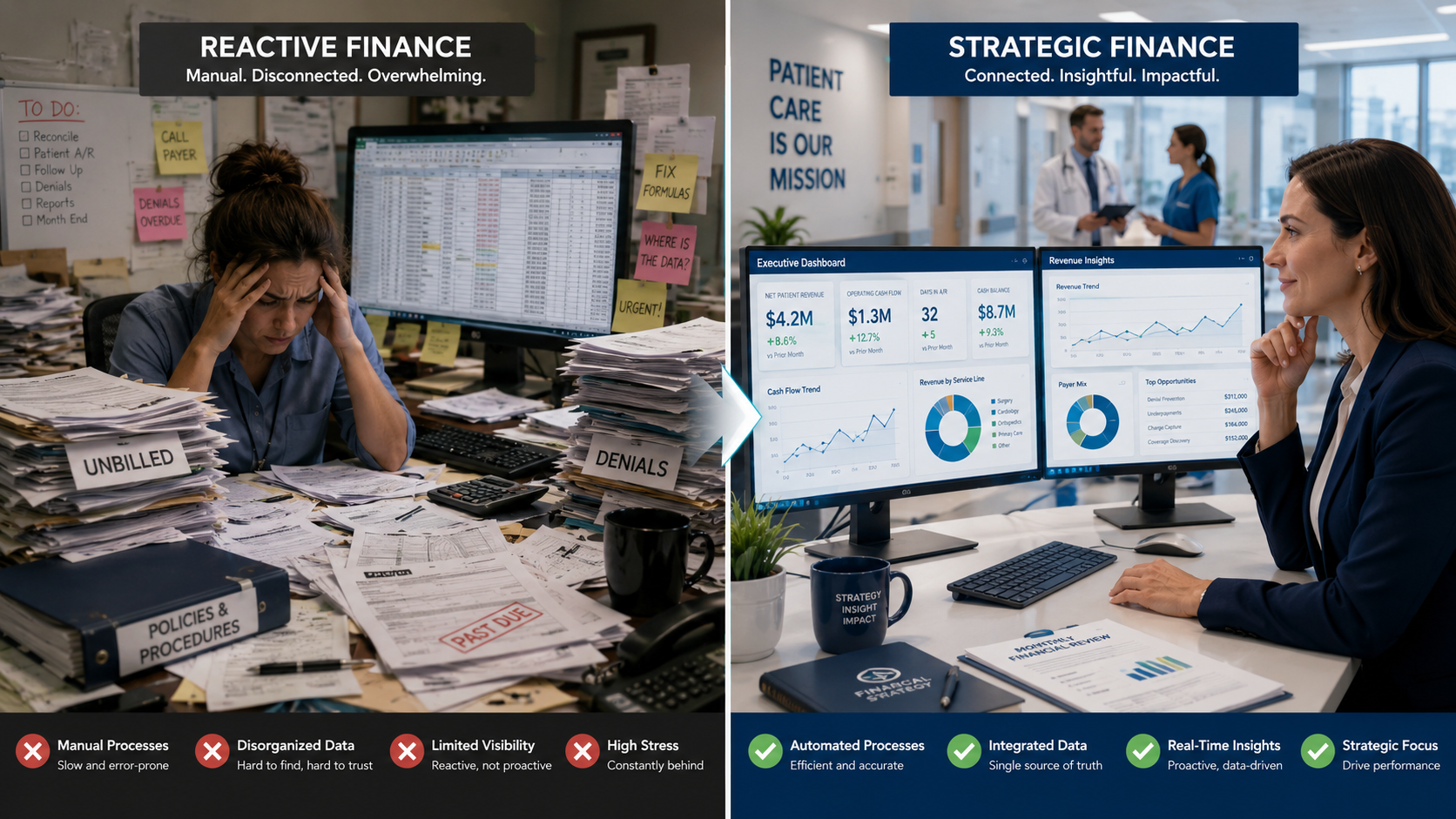
Healthcare finance transformation is the process of upgrading the systems, workflows, reporting, and controls a practice, clinic, or medical group uses to manage money and make decisions, moving from spreadsheets and manual reports to a connected, scalable financial operating system.
The fastest wins come from fixing process and data first, not buying software. Clean books, a repeatable monthly close, and revenue-cycle visibility deliver more value than any new tool bolted onto a broken workflow.
In our experience leading 7+ accounting and ERP system conversions, the organizations that scale cleanly share one trait: leadership can answer "are we collecting what we're owed, and which locations are profitable?" in minutes, not weeks.
Growing healthcare organizations in Rockford and across Northern Illinois face the same core pressures as national systems, denial rates, payer complexity, staffing costs, but with leaner finance teams, which makes scalable systems even more important.
What Is Healthcare Finance Transformation?
Healthcare finance transformation is the process of improving the systems, workflows, reporting, and financial controls that support a healthcare organization's operations, so leaders can see clearly, act faster, reduce revenue leakage, and scale with confidence.
It is not "doing the books better." It is building a financial operating system. In practice, that usually includes:
Cleaner accounting processes and a reliable monthly close
Stronger cash flow visibility and forecasting
Revenue cycle improvement (claims, denials, collections, days in A/R)
ERP or financial-system optimization and integration
Automation of repetitive finance tasks
Executive-ready dashboards that connect numbers to decisions
For a growing practice or clinic, the goal is to move away from scattered information toward a system where leaders can answer critical questions quickly: Are we collecting what we are owed? Which locations or service lines are profitable? Where are expenses rising fastest? Can we afford to hire, expand, or invest? Bookkeeping looks backward; strategic finance helps leadership move forward.
This is closely tied to a broader leadership question we cover in depth in why practices, clinics, and healthcare organizations need financial leadershiptransformation gives leaders the systems, and financial leadership gives them the judgment to use them.
Why Healthcare Organizations Need Better Financial Systems in 2026
The financial environment for healthcare organizations has become more complex. Practices and clinics are not just providing care, they are managing payer contracts, patient balances, compliance requirements, staffing costs, technology expenses, and reporting demands all at once.
The pressure shows up most clearly in the revenue cycle. In an MGMA Stat poll, 60% of medical group leaders reported an increase in their claim denial rates compared to the same period a year earlier (MGMA). The encouraging part: industry analysis from the Healthcare Financial Management Association finds that approximately 90% of those denials are preventable, usually traced back to eligibility, authorization, or documentation gaps that a well-built financial system catches before a claim ever goes out.
Revenue cycle management is harder than it was even two years ago. In 2026, the conversation has shifted from small efficiency tweaks to denial pressure, payer rules, regulation, and financial resilience. Hospitals and insurers are both deploying AI in billing and payment workflows, creating an "AI vs. AI" dynamic that smaller organizations have to keep pace with.
For smaller practices, the core challenge is usually visibility. For larger medical groups, it is scalability. For organizations in transition, it is both. Without strong financial systems, leaders often don't know there's a problem until cash is already tight, reports are already late, or growth has already exposed operational weaknesses.
A scalable financial system gives leadership a clearer view of revenue performance, billing and collections trends, operating expenses, cash flow timing, budget variance, location performance, provider productivity, payer reimbursement behavior, and growth readiness. In simple terms, it helps leaders stop guessing.
The Warning Signs Your Financial Systems Are Holding You Back
Most healthcare organizations don't realize their finance function is underbuilt until growth makes the weakness obvious. These are the patterns we see most often.
1. Reports take too long to prepare
If leadership waits weeks for financial reports, the organization is operating from the past. Delayed reporting creates delayed decisions. Reporting should be timely, consistent, and easy to interpret.
2. Too much depends on one person
Many practices rely on one internal person who understands the spreadsheet, the billing process, and the financial history. That works until it doesn't. A scalable finance operation should not depend on undocumented tribal knowledge.
3. Billing, accounting, and operations are disconnected
Scheduling affects billing. Coding affects reimbursement. Collections affect cash flow. When these areas are disconnected, leadership receives fragmented information. Transformation connects the dots between care delivery, billing activity, accounting records, and executive decision-making.
4. Cash flow feels unpredictable
A healthcare organization can be busy and still struggle financially. High patient volume does not automatically mean strong cash flow, if claims are delayed, denials are rising, or patient balances are aging, growth can actually create pressure.
5. Leaders can't see profitability by location or service line
As organizations grow, overall revenue is not enough. Leaders need to know which locations, providers, and service lines are performing and which need attention. Without that visibility, organizations keep investing in areas that look busy but aren't financially healthy.
The Core Areas of Healthcare Finance Transformation
A strong transformation effort does not begin with software. Software helps, but it never fixes a broken process by itself. The right approach starts with the foundation.
1. Clean financial data
Reliable decisions require reliable data. If the chart of accounts is messy, transactions are misclassified, or revenue categories are unclear, leadership cannot trust the numbers. Clean data is the foundation for everything else. This is also where good healthcare accounting services earn their keep, the discipline of clean books is what makes every downstream report trustworthy.
2. Standardized financial processes
Growing organizations need repeatable workflows: a monthly close, revenue reconciliation, expense categorization, A/P and A/R review, budget review, and a leadership reporting cadence. Without standardization, every month is a scramble. With it, finance becomes predictable, auditable, and scalable.
3. Revenue cycle visibility
Revenue cycle management is one of the most important financial areas in healthcare. A stronger system lets leaders monitor claim submission timing, denial trends, days in A/R, patient collections, payer delays, underpayments, write-offs, and collection rates. Revenue cycle performance is not just a billing issue, it is a leadership issue.
4. Better budgeting and forecasting
A static budget created once a year is rarely enough in a fast-changing environment. Better forecasting helps leaders plan for staffing changes, provider growth, equipment, technology, new locations, service-line expansion, and reimbursement shifts. PwC's 2026 CFO guidance emphasizes finance transformation, AI adoption, risk management, and transparency as priorities for modern finance leaders, all especially relevant in healthcare, where financial decisions affect patient access and staffing.
5. Executive-level reporting
A good report doesn't bury leaders in numbers, it clarifies what changed, why it changed, what it means, and what action to consider. For a practice administrator, clinic owner, CFO, or medical-group executive, the goal is not more reports. It is better insight.
How Finance Transformation Supports Growth
Growth exposes financial weakness. A single-location practice can run on informal processes; as it adds providers, locations, departments, or service lines, the financial system has to mature with it.
Clearer expansion decisions
Before opening a location, hiring providers, or adding services, leadership needs to understand startup costs, expected revenue, payer mix, staffing needs, and break-even timing. Without accurate modeling, growth decisions become guesses.
Stronger cash flow planning
Cash flow is the oxygen of a healthcare organization. Even profitable organizations feel pressure when cash is delayed. Better planning helps leaders prepare instead of react.
Improved accountability
When reporting improves, accountability improves. Departments, locations, and leadership teams see performance clearly, which drives better conversations about goals, costs, staffing, and collections.
Better access to financing or partnerships
Lenders, investors, and acquisition teams want clean financial information. For any organization considering financing, expansion, acquisition, or sale, reliable reporting supports better valuation and stronger negotiations.
The Role of Technology, Without Letting It Lead
Technology should make finance easier to manage, not harder to understand. Modern organizations may use tools for accounting, ERP, billing, payroll, revenue cycle management, business intelligence, budgeting, dashboards, and workflow automation. But the key is not adding more tools, it is building a connected system. A disconnected stack creates confusion; a well-designed system creates clarity.
In 2026, finance leaders are paying close attention to automation, AI, denial prevention, and better reporting. Healthcare organizations need systems that help them understand, validate, and respond to what is happening across the full revenue cycle, not just basic financial administration.
What Smaller Practices and Clinics Should Focus On First
Not every organization needs an enterprise finance department. Smaller practices should focus on the fundamentals.
Start with clean books
If the accounting records aren't accurate, every report built on them is questionable. Make sure revenue, expenses, liabilities, payroll, vendor payments, and reconciliations are clean first.
Create a monthly reporting rhythm
Don't wait until year-end to understand performance. A monthly rhythm keeps the organization aware of revenue trends, expenses, cash flow, and operational issues.
Monitor cash flow weekly
For smaller organizations, a weekly cash flow review surfaces upcoming obligations, expected collections, and pressure points before they become emergencies.
Track the right metrics
A smaller practice needs the right KPIs, not hundreds: monthly revenue, operating expenses, net income, cash on hand, days in A/R, claim denial rate, collections rate, payroll as a percentage of revenue, provider productivity, and patient balance aging.
Document key processes
If a process only exists in someone's head, it isn't scalable. Documenting billing, reporting, reconciliation, month-end close, and vendor payment workflows reduces risk and improves consistency.
What Larger Healthcare Organizations Should Prioritize
Larger organizations need a more mature operating model: department-level reporting by location, provider, and service line; budget ownership across department leaders; forecasting and scenario planning ("what if reimbursement declines, staffing costs rise, or a payer contract changes?"); system integration so accounting, billing, payroll, HR, and operations support one financial picture; and concise, decision-ready board and executive reporting.
Common Mistakes to Avoid During Finance Transformation
Transformation creates major improvements only when done thoughtfully. The most common mistakes:
Buying software before fixing the process. New software often just automates confusion. Process first; technology supports it.
Treating finance as back-office only. Finance affects growth, hiring, patient access, payer strategy, and sustainability, treat it as strategic.
Measuring too many things. Overloaded dashboards become useless. Focus on the metrics that drive decisions.
Ignoring revenue cycle data. Accounting shows results; revenue cycle data often explains why. Leadership needs to see it early.
Waiting for a crisis. The best time to transform is before the system breaks.
Healthcare Finance Support for Rockford and Northern Illinois Organizations
Team Consulting 360 works with healthcare organizations across Rockford, Illinois and the surrounding Northern Illinois and Rock River Valley region. From single-location practices to multi-site medical groups, we help local healthcare leaders build the financial systems they need to grow with confidence.
That includes practices in Rockford and the communities around it, Loves Park, Machesney Park, Belvidere, Rockton, Roscoe, and Cherry Valleyas well as organizations serving patients across Winnebago County and the wider Rock River Valley. Regional healthcare groups here often run leaner finance teams than big-city systems, which is exactly why a clean, scalable financial operating system pays off so quickly.
We support a wide range of healthcare companies and organizations, including:
Independent and group medical practices
Outpatient clinics and specialty clinics
Dental, vision, and behavioral health practices
Urgent care and ambulatory care centers
Physical therapy, rehabilitation, and home health providers
Multi-location medical groups and healthcare networks
Whether your organization is based in Rockford or serves patients across Northern Illinois, the principle is the same: stronger financial systems lead to clearer decisions, healthier cash flow, and more sustainable growth. Local healthcare leaders who understand their numbers are better positioned to serve their communities for the long term.
Final Thoughts: Strong Financial Systems Create Stronger Healthcare Organizations
In 2026, the organizations that grow with confidence won't be the ones with the most complicated systems, they'll be the ones with the clearest. Clean data. Reliable reports. Strong cash flow visibility. Better revenue cycle insight. Practical forecasting. Financial leadership that connects numbers to action.
Healthcare finance transformation isn't about making finance look impressive. It's about making finance useful. When practices, clinics, and medical groups build scalable financial systems, they give themselves the visibility needed to serve patients, support teams, and grow with confidence.
FAQ
What is healthcare finance transformation?
Healthcare finance transformation is the process of improving the financial systems, workflows, reporting, and controls that help a healthcare organization manage money, measure performance, and make better decisions, moving from manual spreadsheets to a connected, scalable financial operating system.
Why do healthcare practices need finance transformation?
Practices need finance transformation when growth, billing complexity, manual reporting, cash flow pressure, or outdated systems make it difficult for leadership to see accurate financial performance and make confident decisions.
What financial systems should a growing clinic have?
A growing clinic should have clean accounting records, consistent monthly reporting, cash flow tracking, revenue cycle visibility, budgeting, forecasting, and clear leadership dashboards.
How does finance transformation improve cash flow?
It improves cash flow by helping leaders see billing delays, claim denials, collection issues, expense trends, and revenue cycle problems earlier, so they can act before cash gets tight.
Is finance transformation only for large healthcare organizations?
No. Smaller practices and clinics benefit just as much by improving bookkeeping, reporting, cash flow visibility, billing workflows, and financial decision-making, often with faster results because they're more nimble.
Serving healthcare across Northern Illinois & southern Wisconsin
Financial leadership for mid-to-large healthcare organizations across Northern Illinois
Team Consulting 360 helps multi-location medical groups, specialty networks, and health-system finance teams across Rockford, Illinois and the wider region (Loves Park, Machesney Park, Belvidere, Rockton, Roscoe, Cherry Valley, Freeport, Byron, Rochelle, DeKalb, Sycamore, Dixon, Sterling, Beloit, WI, Janesville, WI). We work throughout Winnebago, Boone, Ogle, Stephenson, DeKalb, and Lee counties, the Rock River Valley, and the southern-Wisconsin Stateline market. Growing healthcare organizations across Northern Illinois face the same payer complexity, denial pressure, and multi-site reporting challenges as big-city systems, usually with leaner finance teams, which is exactly where clean, scalable, consolidated financial systems pay off fastest.
Healthcare organizations we work with
- Mid-to-large: Multi-location medical groups, specialty networks, ambulatory and health-system finance teams
- Growing: Group practices, clinics, and mid-market organizations scaling across locations
- Smaller: Single-location practices and businesses building their financial foundation
Ready to move forward?
Let's build financial systems your team can trust
Book a free, no-pressure clarity call with Team Consulting 360, or grab our free finance-transformation guide. We'll help you see where your reporting, cash flow, and financial systems stand today, and map the fastest path to clean numbers and confident decisions.
Free 30-minute call · No obligation · Real answers
Frequently Asked Questions
What is healthcare finance transformation?
Why do healthcare practices need finance transformation?
What financial systems should a growing clinic have?
How does finance transformation improve cash flow?
Is finance transformation only for large healthcare organizations?