What an in-house bookkeeper, controller, or CFO really costs against outsourced accounting, with the arithmetic shown and honest limits, from a Rockford CPA.
Steven JohnsonCPA, MBA, Finance Transformation & ERP Implementation Specialist
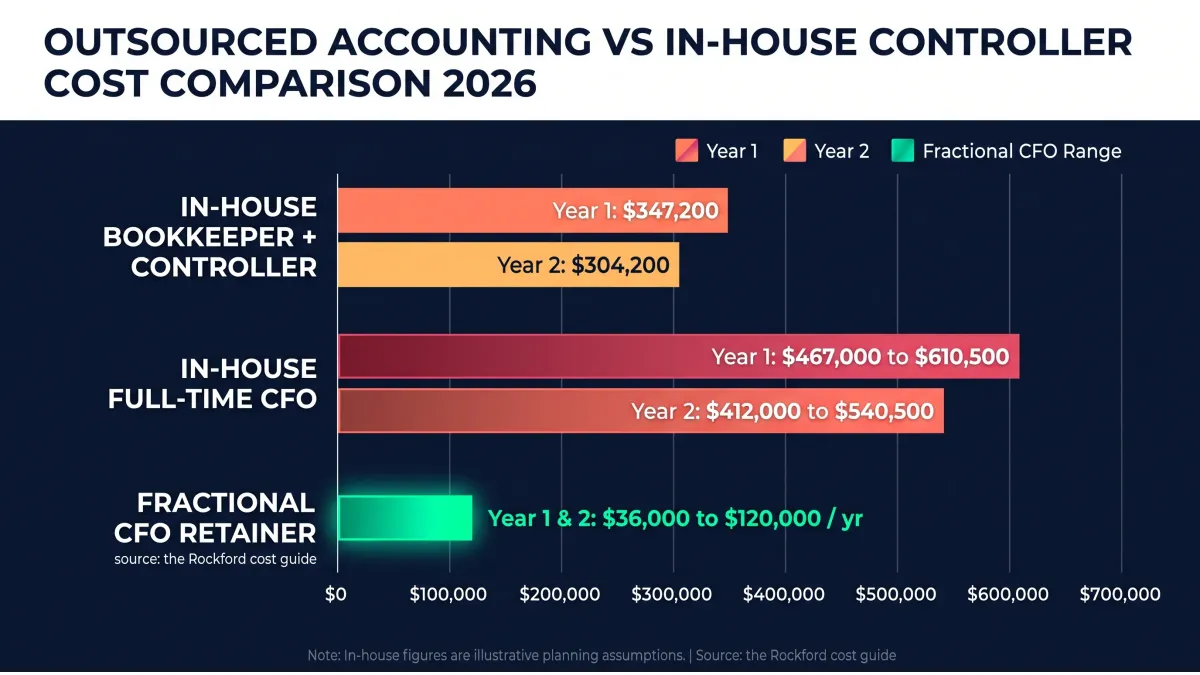
Figure 1: Total Year-1 loaded cost comparison between full-time internal hires and a fractional CFO retainer. Illustrative planning assumptions, not survey data.
Figure 1: Total Year-1 loaded cost comparison between full-time internal hires and a fractional CFO retainer. Illustrative planning assumptions, not survey data.
Figure 1: Total Year-1 loaded cost comparison between full-time internal hires and a fractional CFO retainer. Illustrative planning assumptions, not survey data.
Direct Answer: Under the planning assumptions shown below, an in-house bookkeeper plus controller costs about $347,200 in Year 1 and $304,200 a year after that, and a full-time CFO costs $467,000 to $610,500 in Year 1. For the senior layer, our own Rockford cost guide puts fractional CFO retainers in this market at $3,000 to $10,000 per month ($36,000 to $120,000 per year). The gap is large, but the options are not like-for-like, and the in-house figures are illustrative, not survey data.
Why a single in-house finance hire stops working between $2M and $50M
When a growing healthcare group, manufacturing firm, or multi-entity service company in Northern Illinois crosses roughly $2M to $50M in annual revenue, the owner usually faces the same structural trap:
A bookkeeper is too junior for the work that has appeared. A bookkeeper can record bank feeds and code routine expenses, but multi-entity consolidations, accrual adjustments, overhead absorption, and a forward-looking 13-week cash flow forecast sit outside that job.
A full-time CFO should not be doing daily reconciliations. Paying a CFO-level salary for someone to spend 20 hours a week repairing QuickBooks or ERP journal entries wastes the most expensive seat in the department.
None of that means outsourcing is automatically right. It means the real question is which layer of finance work you are short of, and what each way of filling it costs.
Those are national medians across all industries and company sizes, so they are a floor for planning, not a quote for a Rockford hire. The salaries in the example below ($65,000 for a bookkeeper, $150,000 for a controller, $275,000 to $350,000 for a CFO) are our planning assumptions, not BLS figures. The $65,000 bookkeeper sits between the clerk and accountant medians, the $150,000 controller is slightly below the all-financial-manager median, and the CFO range is well above it because it prices a senior executive seat.
Illustrative example (hypothetical numbers): what the in-house options cost
The table below shows the arithmetic. Every input is an assumption, labelled as one, and you should replace each with your own quote before relying on the result.
Assumptions: employer payroll taxes and benefits at 28% of base; bonus at 15% of the controller's base and 20% to 25% of the CFO's base; a one-time recruiting fee at 20% of first-year base for each hire; and a small allowance for CPE, training, and tools. The example leaves out equity, severance risk, ramp time, and software licenses, all of which would raise the in-house totals.
Cost component
Bookkeeper ($65,000) plus controller ($150,000)
Full-time CFO ($275,000 to $350,000 base)
Base salaries
$215,000
$275,000 to $350,000
Payroll taxes and benefits (28% of base)
$60,200
$77,000 to $98,000
Bonus (15% of controller base; 20% to 25% of CFO base)
$22,500
$55,000 to $87,500
Recruiting fee (20% of first-year base)
$43,000
$55,000 to $70,000
CPE, training, and tools (assumption)
$6,500
$5,000
Year 1 total
$347,200
$467,000 to $610,500
Year 2 and later (no recruiting fee)
$304,200
$412,000 to $540,500
Two details change how you should read this. First, the recruiting fee is a one-time cost, so the honest long-run comparison is the Year 2 row, not the Year 1 row. Second, if you are hiring only a controller at a $150,000 base, the same assumptions give $251,000 in Year 1 ($150,000 plus $42,000 benefits, $22,500 bonus, $30,000 recruiting, and $6,500 for CPE and tools) and $221,000 a year after that.
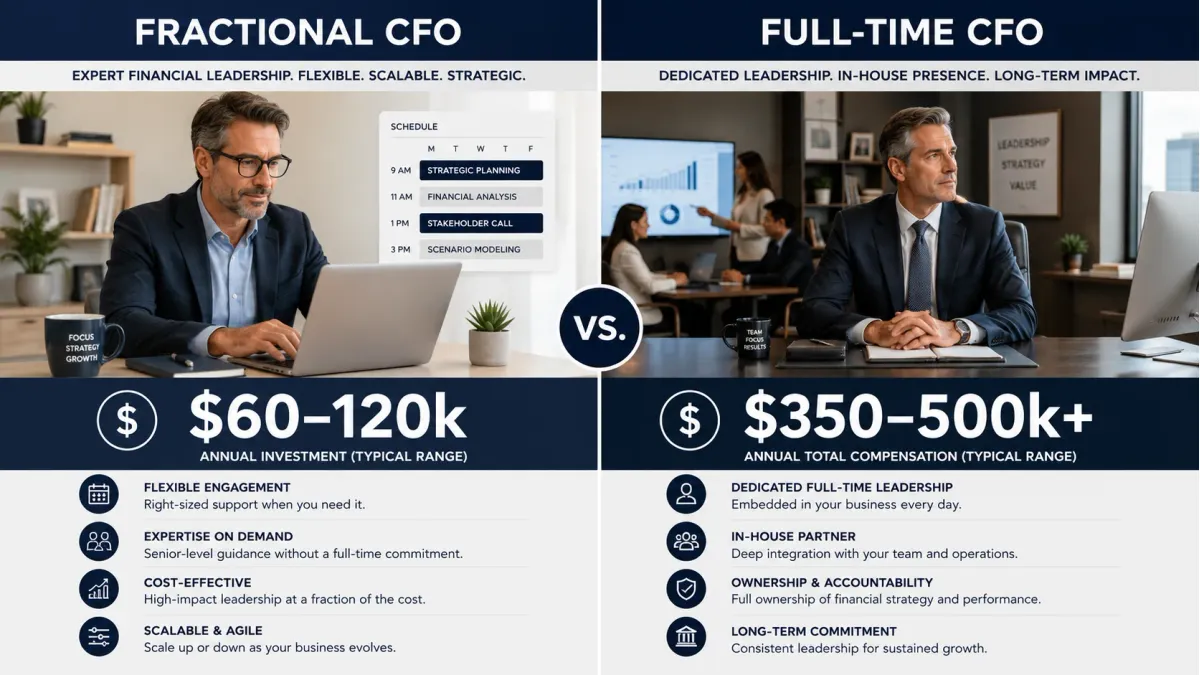
On the outsourced side, the only price this site publishes is for the fractional CFO layer: our Rockford cost guide puts retainers at $3,000 to $10,000 per month ($36,000 to $120,000 per year) in this market. Outsourced bookkeeping and controller support is priced by scope, entity count, ERP platform, and transaction volume, so get written quotes for your exact scope instead of relying on a range from an article.
Putting the pairs side by side, using the table above:
Bookkeeper plus controller: this article has no published price for an outsourced equivalent, so it does not state a gap. Compare written quotes against the in-house figure of $347,200 in Year 1 and $304,200 in Year 2 and later.
Full-time CFO versus a fractional CFO retainer: using the retainer range of $36,000 to $120,000 per year, the gap in Year 1 is $347,000 at the narrowest (lowest CFO cost of $467,000 against the highest retainer of $120,000) and $574,500 at the widest (highest CFO cost of $610,500 against the lowest retainer of $36,000). In Year 2 and later, with no recruiting fee, the range is $292,000 to $504,500.
Treat those gaps as an upper bound on the savings. An employee is available every day, learns your business over years, and can be pulled into any problem. An outsourced provider brings more varied experience and no payroll, but you share its attention, and the scope is whatever the engagement letter says. If your finance workload genuinely needs 40 hours a week of one person, the in-house number buys something the outsourced number does not.
How the finance layers split, and where Team Consulting 360 fits
Finance work in a growing company sits in three layers, and the layers need different people:
Daily transaction accuracy: bank feeds, accounts payable approvals, invoicing, and payroll entries. This is bookkeeping, and it stays with an in-house bookkeeper or an accounting provider. Team Consulting 360 does not describe its fractional CFO work as bookkeeping.
Close and controls: the month-end close, reconciliations, and a reporting rhythm the team can run. This is the layer our process optimization work addresses, because a close that takes three weeks usually has workflow causes that a new hire alone will not fix.
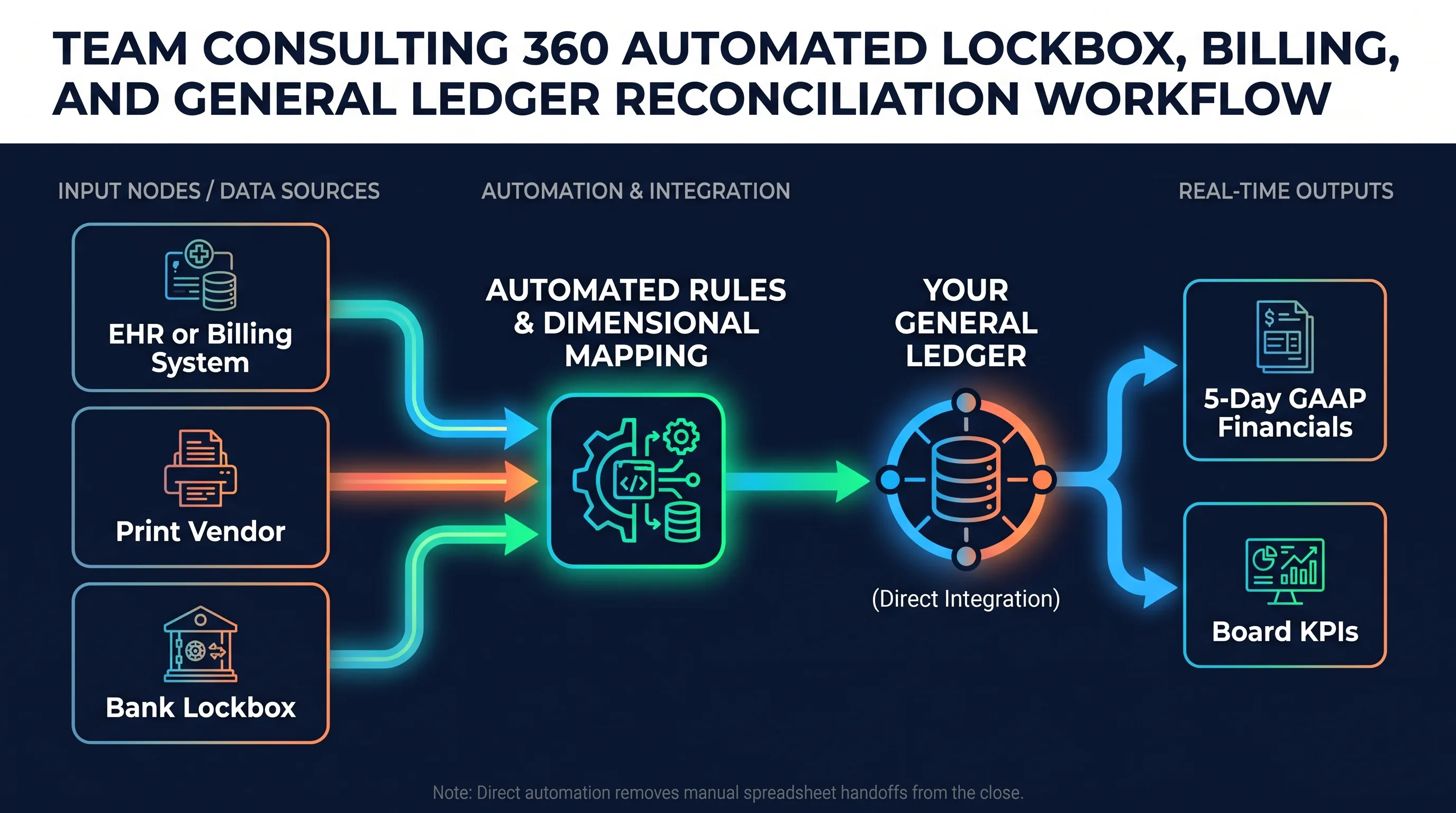
Forward-looking finance: cash forecasting, margin analysis, bank covenant tracking, and decisions that shape the next year. This is the layer of fractional CFO advisory, and where a system is the constraint, ERP implementation.
Our work is organized around the TEAM Framework (Timely reporting, Essential metrics, Aligned systems, Measurable impact). Most organizations do not need all three layers from one provider. A company with a capable bookkeeper may only need the second and third layers on top. If your organization is a healthcare practice, our guide to what healthcare accounting services should include in 2026 shows how those layers map to payer, billing, and multi-site reporting.
Figure 2: How integrating billing subledgers and bank lockboxes directly into the general ledger removes spreadsheet handoffs from the close.
Figure 2: How integrating billing subledgers and bank lockboxes directly into the general ledger removes spreadsheet handoffs from the close.
The 5-signal test: when outsourcing is worth a serious look
If two or more of the following describe your organization today, an outsourced controller or CFO structure deserves a real quote. These are our rules of thumb from client work, not industry statistics.
Your month-end close takes longer than 7 business days, or numbers change after financial reports have been distributed.
You operate multiple legal entities, clinic locations, or MSO and PC structures that are still consolidated by hand in Excel.
Your tax preparer tells you every March that the trial balance needs thousands of dollars of cleanup before filing.
You expect a bank refinancing, an ERP migration, or private equity due diligence within the next 12 to 24 months.
The CEO or managing partner spends 5 or more hours a week approving routine accounting entries or chasing cash surprises.
When staying in-house is the better call
Outsourcing is not a cure for every finance problem. Keep the work in-house, or add an in-house hire, when:
your transaction volume needs a full-time person processing it every day;
your finance function is already stable, and the gap is only forward-looking judgment, which is the case for a fractional CFO on top of an internal controller rather than a replacement for one;
you need someone physically on site for inventory counts, bank runs, or staff supervision; or
you want to build a finance team as a long-term asset, accepting the fixed cost and the time it takes to hire well.
A common middle path is to keep a bookkeeper in-house for daily entry and outsource the controller and CFO layers. That keeps daily capacity close while buying the senior review you could not justify as a full-time salary. If you are weighing that structure, our process optimization work is often the first step, because a close that takes three weeks usually has workflow causes that a new hire alone will not fix.
Financial leadership for mid-to-large healthcare organizations
Team Consulting 360 works with healthcare finance teams across the Rock River Valley, the Stateline area, and Northern Illinois,
and remotely nationwide. Growing healthcare organizations face the same payer complexity,
denial pressure, and multi-site reporting challenges as big-city systems, usually with leaner
finance teams.
Healthcare organizations we work with
Mid-to-large: Multi-location medical groups, specialty networks, ambulatory and health-system finance teams
Growing: Group practices, clinics, and mid-market organizations scaling across locations
Smaller: Single-location practices and businesses building their financial foundation
Ready to move forward?
Let's build financial systems your team can trust
Book a free, no-pressure clarity call with Team Consulting 360, or grab our free
finance-transformation guide. We'll help you see where your reporting, cash flow, and
financial systems stand today, and map the fastest path to clean numbers and confident
decisions.
Free 30-minute call · No obligation · Real answers
Frequently Asked Questions
How much does outsourced accounting and controller support cost in 2026?
It depends on scope, entity count, ERP platform, and transaction volume, so get written quotes for your exact scope. For the fractional CFO layer, our Rockford cost guide puts typical retainers in this market at $3,000 to $10,000 per month, or roughly $150 to $400 per hour for project work. This article's planning assumptions put a full-time CFO at $467,000 to $610,500 in Year 1.
Do I still need a tax CPA if I hire an outsourced accounting and controller firm?
Plan on keeping a tax preparer. Outsourced accounting and controller work covers year-round operational accounting, month-end close, balance sheet reconciliations, and cash flow reporting. Its benefit at tax time is a reconciled year-end file, which gives your tax preparer cleaner books and usually reduces cleanup work in March.
Can an outsourced finance provider work inside our existing ERP or accounting software?
It depends on the provider, so ask for named experience on your platform. Team Consulting 360's ERP work covers NetSuite, SAP, and Microsoft Dynamics, and its published content also covers Sage Intacct. If you are outgrowing your current system, ERP selection and implementation are a separate engagement.
What is the difference between an outsourced controller and a fractional CFO?
A controller owns the accuracy of the books, the monthly close, and reconciliations. A fractional CFO looks forward: cash forecasting, pricing and margin analysis, banking relationships, and decisions that shape the next year. Many growing companies need both layers, but not necessarily from the same hire or at the same hours.
Written by
Steven Johnson, CPA, MBA
Founder & Finance Transformation Specialist at Team Consulting 360
Steven helps growing healthcare practices, service businesses, and mission-driven organizations turn financial complexity into clear reporting, stronger controls, and better decisions. Over 20+ years he has led 7+ accounting and ERP system conversions and supported organizations scaling from $10M to $100M.