Critical Access Hospital Cost Reports: Reimbursement Strategy, Not Compliance Paperwork
Medicare pays critical access hospitals based on allowable costs, so the annual cost report is reimbursement strategy, not paperwork. Here are the levers.


For a critical access hospital, the annual Medicare cost report is not paperwork, it is the document that sets what the hospital gets paid.
Key Takeaways
The critical access hospital cost report determines actual Medicare payment, because Medicare reimburses CAHs based on allowable costs (the statutory basis is 101 percent of allowable costs), so cost report decisions move real dollars, not just compliance boxes.
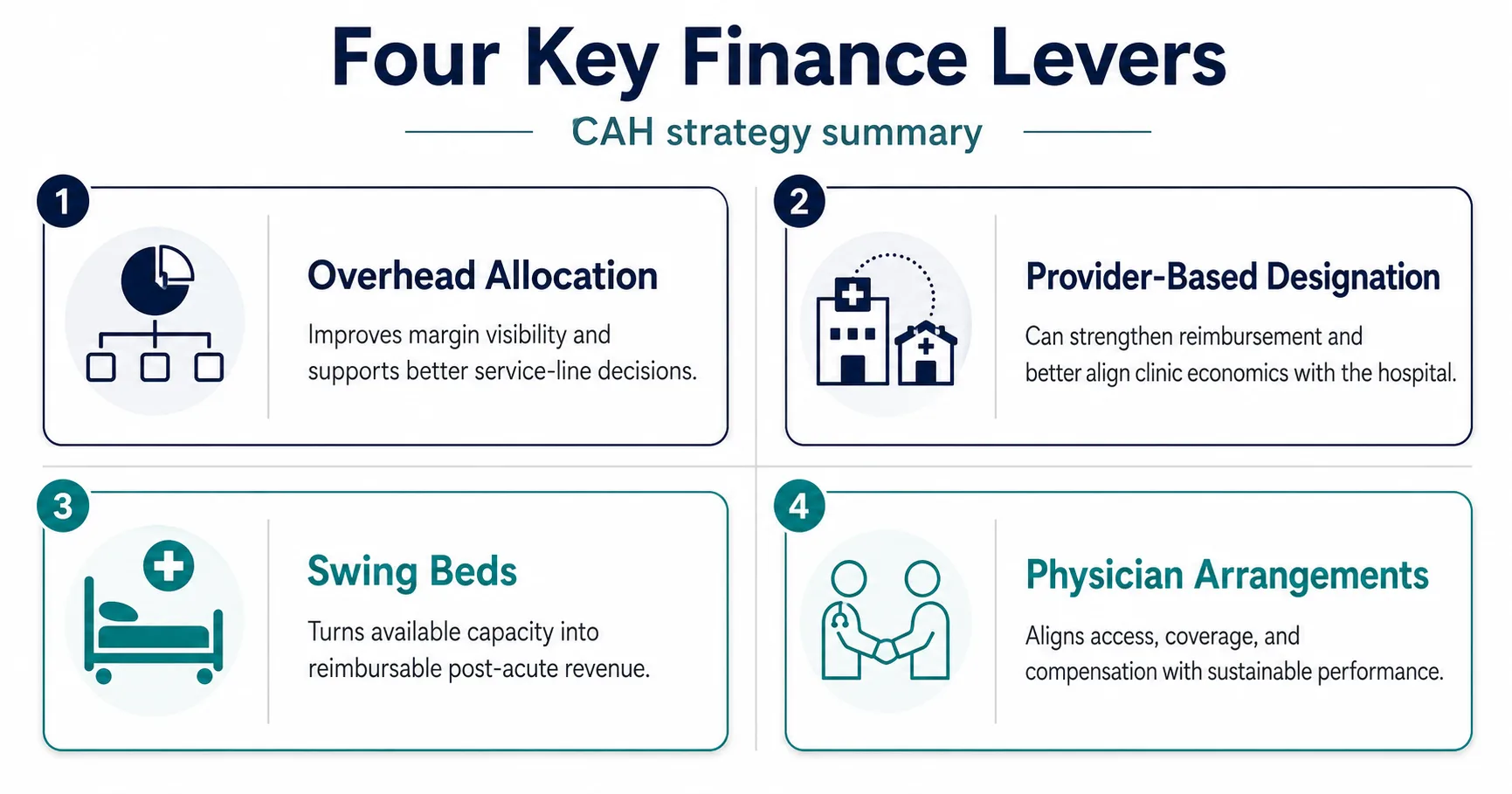
Four levers carry most of the reimbursement impact: overhead allocation statistics, provider-based clinic designation, swing-bed program design, and how physician arrangements are structured and documented.
The stakes are high: about half of rural hospitals ran negative operating margins from patient services between 2017 and 2022, and more than 100 rural hospitals closed between January 2013 and February 2020.
In our engagements with rural hospital finance teams across Ogle, Lee, and Stephenson counties, the hospitals that treat the cost report as a year-round discipline, not a spring filing scramble, consistently protect margin their peers leave on the table.
What a Critical Access Hospital Cost Report Actually Does
A critical access hospital cost report is the annual Medicare filing, submitted on Form CMS 2552-10, that determines how much the hospital actually gets paid, because Medicare reimburses critical access hospitals based on their allowable costs rather than fixed prospective rates. Every Medicare-certified institutional provider must file an annual cost report with its Medicare Administrative Contractor, but for a CAH the filing carries far more weight than it does for a larger hospital.
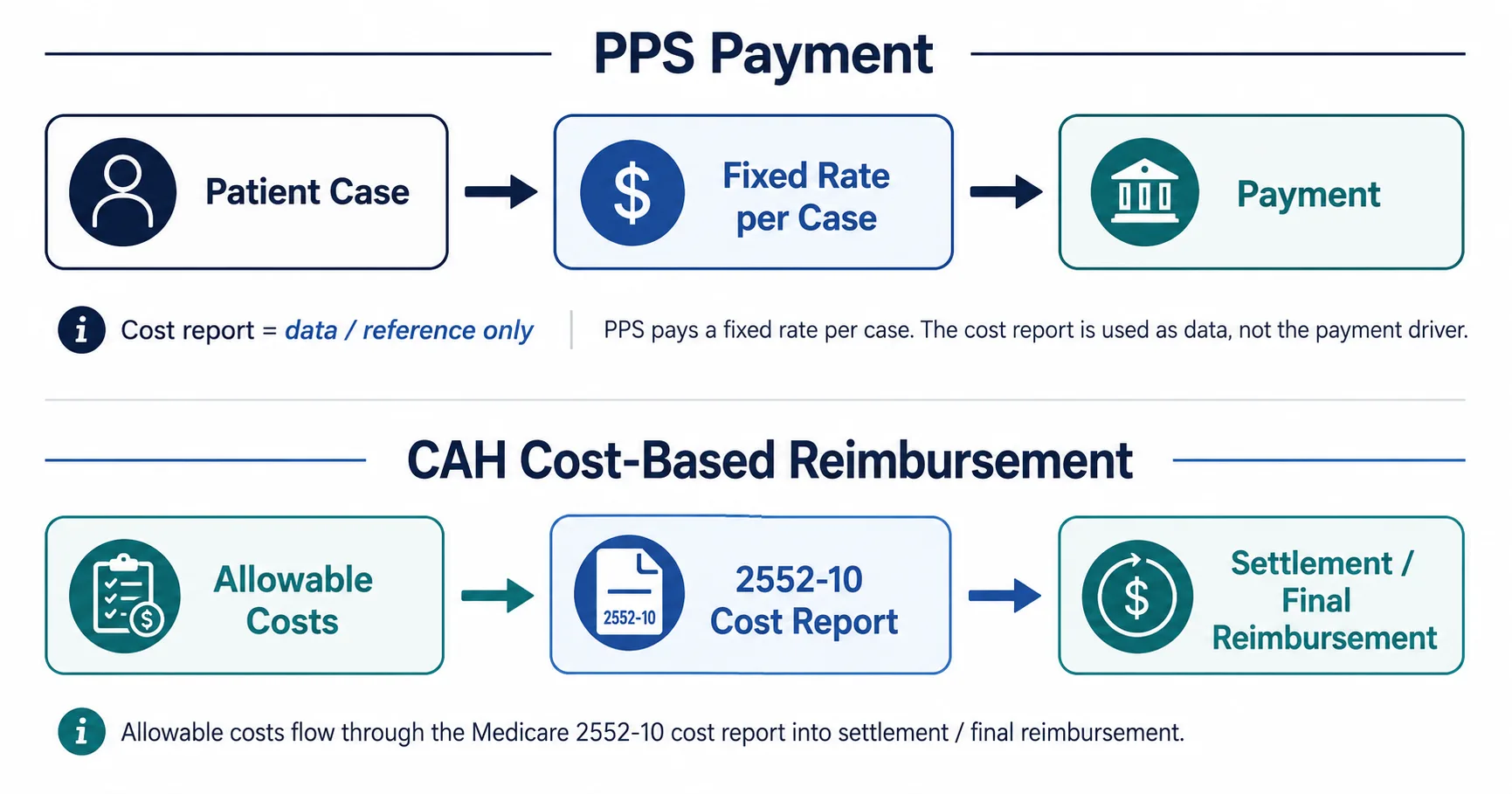
Here is the distinction that most board members never hear explained. A prospective payment system (PPS) hospital gets paid a predetermined rate per case or per visit; its cost report mostly feeds data back to CMS. A CAH is different. Under the statute, Medicare pays critical access hospitals 101 percent of allowable costs for inpatient, outpatient, and swing-bed services furnished to Medicare beneficiaries. The cost report is where "allowable costs" gets defined, allocated, and settled. Interim payments during the year are estimates; the cost report is the true-up that decides whether the hospital owes Medicare money or Medicare owes the hospital.
The consequence: decisions that would be accounting trivia at a PPS hospital change actual reimbursement at a CAH. Overhead allocation, provider-based status, swing beds, physician contract structure. Each flows through the cost report into payment.
One honest caveat before the levers. The 101 percent figure is the statutory basis, not the check that arrives. Sequestration trims Medicare payments, some costs are not allowable, and settlement adjustments happen, so effective reimbursement usually lands below the headline number. The levers below defend the allowable cost base; they do not inflate it.
Lever 1: Overhead Allocation Is Where Quiet Money Hides
The cost report allocates overhead departments (housekeeping, plant operations, administration, dietary) to revenue-producing departments using statistics: square footage, accumulated costs, meals served, pounds of laundry. Those statistics decide how much overhead lands in cost centers that Medicare reimburses on a cost basis.
The problem is that allocation statistics rot. A hospital renovates a wing, converts storage into a therapy gym, closes an outpatient department, and nobody updates the square footage worksheets for five years. The allocation keeps running on a floor plan that no longer exists. When statistics understate the space and support consumed by Medicare-heavy departments, allowable cost is understated and reimbursement quietly leaks, year after year.
The fix is not aggressive. It is accurate. Walk the building annually, refresh the square footage schedule, revisit whether the default allocation basis still reflects how each overhead department actually supports operations. In our experience, a statistics refresh after any renovation or service line change is one of the highest-return afternoons a CAH finance team can spend.
Lever 2: Provider-Based Clinic Designation
When a clinic qualifies as provider-based, its costs and services roll into the hospital's cost report instead of being paid on the physician fee schedule as a freestanding practice. For a CAH, that typically means the clinic's facility costs join the cost-based reimbursement pool, which can meaningfully improve the economics of primary care the hospital was going to subsidize anyway.
Provider-based status is a designation with real requirements: integration of operations, shared licensure and administration, public awareness, billing rules, and attestation exposure if the facts do not match the paperwork. It changes how patients are billed, and beneficiary coinsurance can differ from the freestanding model, so the decision deserves analysis, not enthusiasm. Modeled well, though, it is often the difference between a clinic the board tolerates as a loss leader and a clinic that carries its own weight. This is exactly the kind of structural decision we walk through in healthcare finance transformation work: the reimbursement model should be designed, not inherited.
Lever 3: Swing-Bed Program Design
CAH swing bed reimbursement is one of the clearest examples of the cost-based advantage. A swing bed lets a CAH use the same licensed bed for acute care or skilled nursing level care as the patient's needs change. While skilled nursing facilities are paid under a prospective system, CAH swing-bed services are paid on the cost basis. For a 25-bed hospital, a well-run swing-bed program does three things at once: it keeps post-acute patients in their own community instead of 40 miles away, it raises occupancy of beds the hospital is already staffing, and it adds patient days to a reimbursement model that pays on cost.
Program design matters more than program existence. Admission criteria, therapy staffing, discharge planning, and documentation discipline decide whether swing beds add margin or add survey findings. The hospitals that do this well treat swing beds as a service line with its own dashboard, not a billing checkbox.
Lever 4: Physician Arrangement Structure
Physician compensation is usually a CAH's largest contracted expense, and how each arrangement is structured decides how much of it is allowable on the cost report. Time spent on direct patient care billed under Part B is treated differently from availability coverage, medical direction, and administrative duties. Without time studies and clear contract language allocating the roles, a MAC auditor will make the allocation for you, and auditors do not err in the hospital's favor.
The practical discipline: every physician and advanced-practice contract should state what is being purchased (clinical services, call coverage, medical direction), supported by periodic time studies that match the contract. This unglamorous work slips first when a small finance office is stretched thin, which is our core argument for dedicated financial leadership even below full-time CFO scale.
When NOT to Pull These Levers
Cost-based reimbursement rewards structure, but not every structure fits every hospital, and the honest analysis sometimes says no.
Skip provider-based conversion when clinic volume is too low. The designation carries permanent compliance overhead: attestation exposure, billing complexity, and audit risk. A clinic seeing a handful of patients a day may never recover those costs, and the billing change can affect what patients owe.
Skip swing beds when census cannot support them. If the community's post-acute demand will not sustain a consistent program, the added staffing, training, and survey burden outweighs the cost-based upside. A program that averages one occupied swing bed is a compliance program, not a revenue program.
Skip aggressive allocation positions entirely. The goal is an accurate, defensible cost base. Positions that invite MAC adjustments, reopenings, and interest clawbacks trade a one-year gain for a multi-year problem.
Do not chase reimbursement the operation cannot document. Every lever above fails at audit without the underlying records: square footage schedules, time studies, provider-based attestation files. Documentation is the lever behind the levers.
If your team cannot say with confidence which of the four levers are live opportunities, that is a diagnostic problem before it is a reimbursement problem. It is the same standard we set out in what to expect from healthcare accounting services: a partner should quantify the opportunity honestly, including when the answer is "leave it alone."
The Regional Stakes: Cost Report Discipline Is How Independents Stay Independent
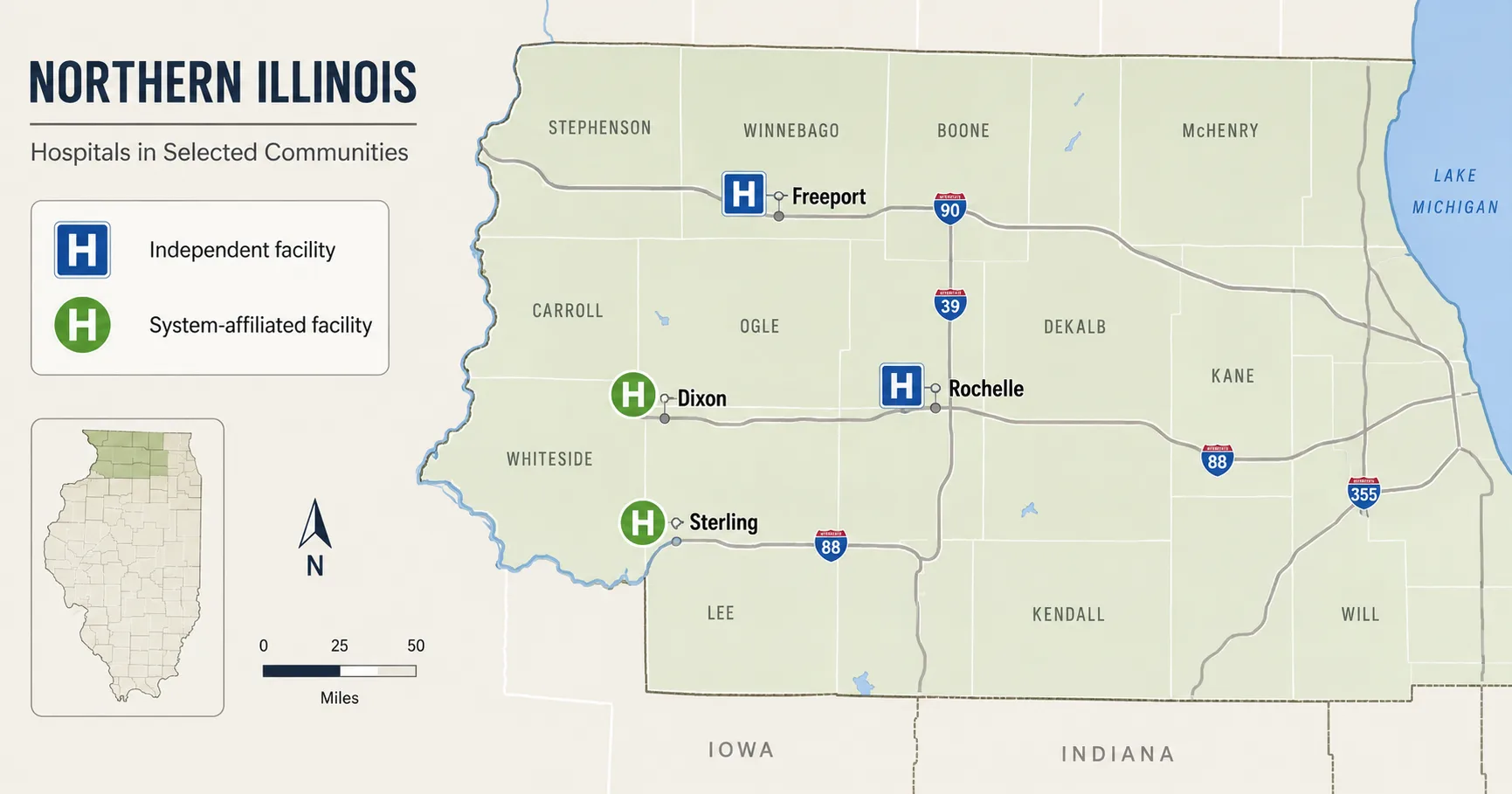
The consolidation wave across rural Northern Illinois is the backdrop for all of this. Dixon's 80-bed KSB Hospital merged into OSF HealthCare on January 1, 2025, becoming OSF Saint Katharine Medical Center. Freeport's FHN joined Mercyhealth on January 1, 2026. Meanwhile Rochelle Community Hospital, an independent 25-bed critical access hospital founded in 1923, continues serving Ogle and surrounding counties on its own charter, and CGH Medical Center in Sterling remains a municipally affiliated independent. Independence is not free. It is financed, in meaningful part, by collecting everything the reimbursement model legitimately allows.
The national numbers explain the urgency. The American Hospital Association reports that about half of rural hospitals had negative operating margins from patient services between 2017 and 2022. The Government Accountability Office found that more than 100 rural hospitals closed between January 2013 and February 2020, and residents in those communities traveled about 20 miles farther for common services afterward. For a CAH board in Rochelle, Sterling, or a comparable community, the cost report is not an accounting formality. It is one of the few levers of financial self-determination the hospital fully controls.
Making the Cost Report a Year-Round Discipline
The failure mode we see most often is treating the cost report as an annual event: the year closes, the deadline nears five months later, and a preparer assembles the filing from whatever the general ledger contains. Filed that way, the report describes the year. Managed year-round, it shapes the year.
A working rhythm looks like this. Quarterly, estimate the settlement position so the balance sheet reserve is real and the board is never surprised by a payback. Annually, refresh allocation statistics and review interim rates against actual cost trends. Before any structural decision (opening a clinic, adding a service, signing a physician contract), model the cost report impact first, not after. And keep watching payment policy: rural payment rules change, and the Medicare Payment Advisory Commission's reports to Congress are the earliest reliable signal of where CAH policy discussion is heading.
None of this requires a big finance department. It requires someone accountable for reimbursement strategy, whether that is an in-house controller with the right support or fractional leadership. In our engagements, the pattern is consistent: the discipline costs a few days a quarter and defends sums that show up directly in settlement.
Final Thoughts: The Filing That Pays You Back
Most Medicare paperwork costs a hospital money to complete. The critical access hospital cost report is the rare filing that pays back the attention invested in it, because at a CAH the report does not describe reimbursement, it determines it. Overhead statistics, provider-based designation, swing-bed design, and physician arrangements are the four places that attention compounds. For the independent hospitals still serving Ogle, Lee, and Stephenson counties on their own charters, that compounding is not an accounting nicety. It is part of how they stay independent.
Serving healthcare across Northern Illinois & southern Wisconsin
Financial leadership for mid-to-large healthcare organizations across Northern Illinois
Team Consulting 360 helps multi-location medical groups, specialty networks, and health-system finance teams across Rockford, Illinois and the wider region (Loves Park, Machesney Park, Belvidere, Rockton, Roscoe, Cherry Valley, Freeport, Byron, Rochelle, DeKalb, Sycamore, Dixon, Sterling, Beloit, WI, Janesville, WI). We work throughout Winnebago, Boone, Ogle, Stephenson, DeKalb, and Lee counties, the Rock River Valley, and the southern-Wisconsin Stateline market. Growing healthcare organizations across Northern Illinois face the same payer complexity, denial pressure, and multi-site reporting challenges as big-city systems, usually with leaner finance teams, which is exactly where clean, scalable, consolidated financial systems pay off fastest.
Healthcare organizations we work with
- Mid-to-large: Multi-location medical groups, specialty networks, ambulatory and health-system finance teams
- Growing: Group practices, clinics, and mid-market organizations scaling across locations
- Smaller: Single-location practices and businesses building their financial foundation
Ready to move forward?
Let's build financial systems your team can trust
Book a free, no-pressure clarity call with Team Consulting 360, or grab our free finance-transformation guide. We'll help you see where your reporting, cash flow, and financial systems stand today, and map the fastest path to clean numbers and confident decisions.
Free 30-minute call · No obligation · Real answers
Frequently Asked Questions
How are critical access hospitals reimbursed by Medicare?
Do critical access hospitals really get 101 percent of costs?
When is the Medicare cost report due?
What moves reimbursement on a CAH cost report?
Why are rural hospitals closing?