Therapy Practice Profit Margins: What Healthy Looks Like for Counseling and Behavioral Health Groups
Solo therapy practices often clear 20 to 40 percent margins while groups compress under 10 percent. Here is the per-provider math that decides which you get.


Key Takeaways
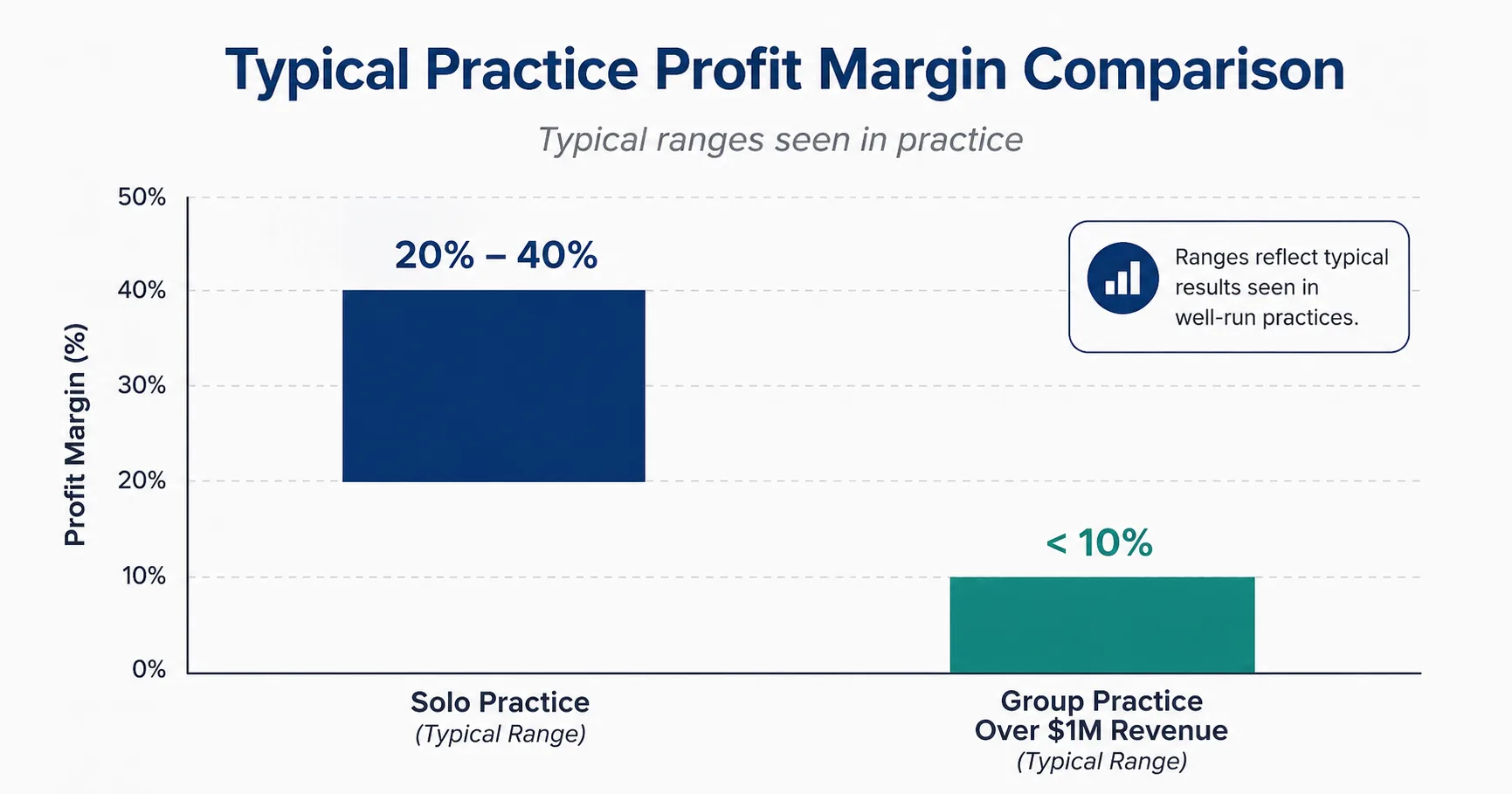
A healthy therapy practice profit margin depends on the model: solo practices often keep 20 to 40 percent of collections as owner profit, while group practices frequently compress to under 10 percent once revenue passes $1 million.
The compression is arithmetic, not mismanagement: clinician compensation typically absorbs 50 to 60 percent of revenue, and the admin layer (billing, intake, practice management) takes another bite most owners never budget.
Run the group by three numbers: margin per provider, clinician utilization, and collections per kept session. Total revenue by itself will flatter you.
In our engagements with independent practices across Rockford, DeKalb, and Sycamore, the owners who model a hire's fully loaded cost before posting the job are the ones whose groups still pay better than their old solo caseload did.
What Is a Healthy Therapy Practice Profit Margin?
A healthy therapy practice profit margin depends almost entirely on the model you run. In the independent practices we work with, a solo clinician at a full caseload commonly keeps 20 to 40 percent of collections as profit after real expenses. A group practice is a different animal: once a counseling or behavioral health group passes roughly $1 million in revenue, owner margins under 10 percent are common. Those are typical market ranges we see in practice, not audited industry statistics, but the direction is remarkably consistent.
The reason owners find this shocking is that revenue and profit move in opposite emotional directions. A group billing $1.4 million feels like a business that made it. Yet after clinician splits, payroll taxes, billing staff, rent on more offices, and the software stack, that group can put less in the owner's pocket than a disciplined solo caseload once did, with far more risk attached.
None of this means group practice is a bad business. It means group practice is a margin business, and margin businesses are run on unit math. The unit here is the provider.
Why Group Margins Compress: The Per-Provider Math
Walk one clinician through the model and the compression stops being mysterious.
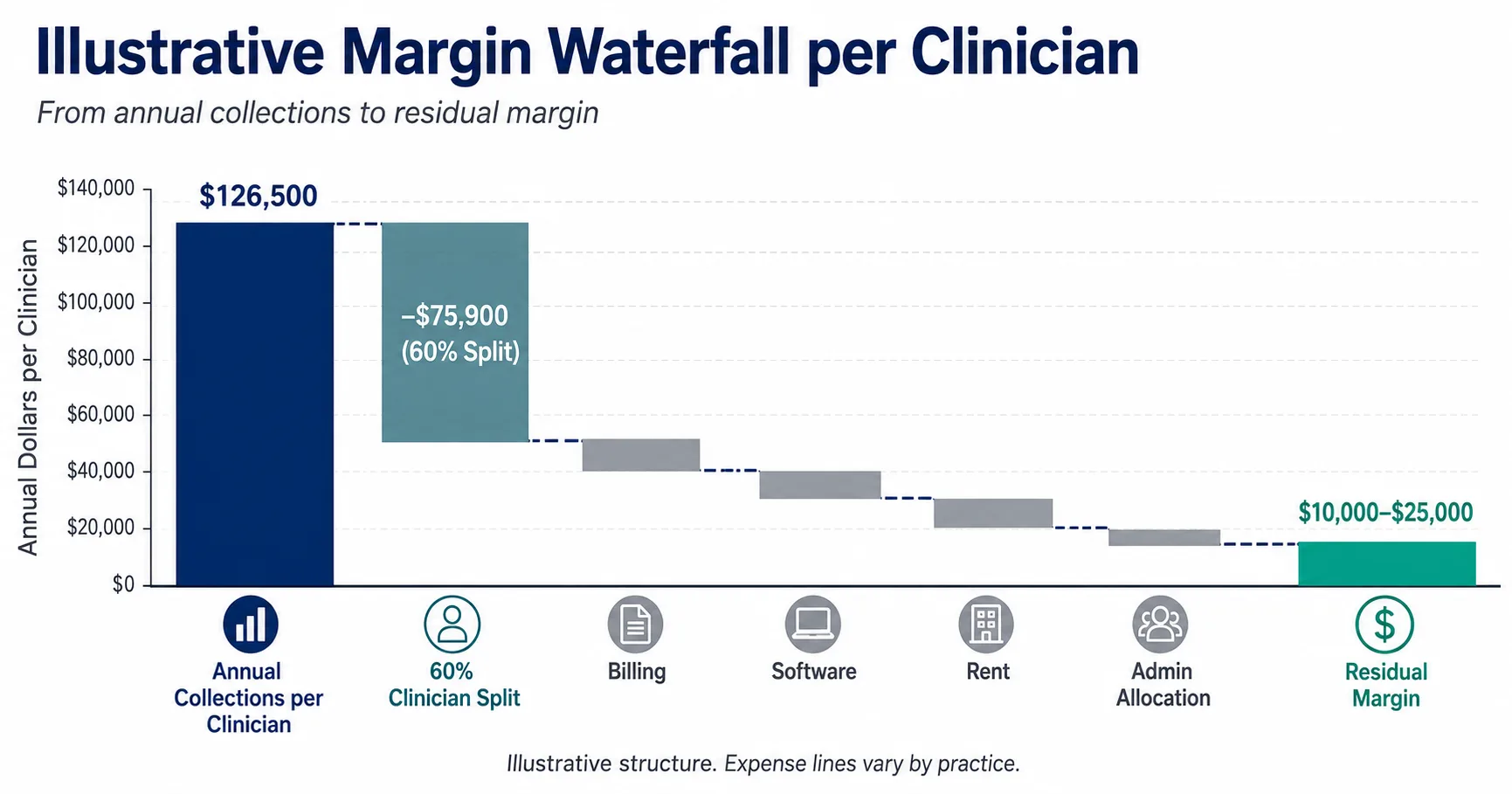
Say an associate therapist averages $110 in collections per kept session and holds 25 clinical hours a week for 46 working weeks. That is 1,150 sessions and about $126,500 in annual collections. On a 60/40 split (60 percent to the clinician), the practice keeps roughly $50,600 before anything else gets paid. Out of that come billing costs, the EHR seat, telehealth and scheduling software, credit card fees, the clinician's share of rent, and a slice of every admin salary. In our modeling for owners, the practice's residual per full-time clinician often lands between $10,000 and $25,000. Multiply by five clinicians and you have a real business. Divide by the hours the owner now spends managing it and the picture gets more honest.
The split decides more than any other lever
A 50/50 split roughly doubles the practice's gross margin per provider compared with 60/40, but it also decides who you can recruit. In a market where clinicians can go solo with a laptop and a telehealth platform, aggressive splits produce turnover, and turnover produces empty calendar slots that cost more than the split ever saved. The split is a pricing decision. Set it from the math, then test it against your local hiring reality.
People costs run 50 to 60 percent of revenue
Across the counseling groups we see, total compensation (clinician splits or salaries plus admin payroll) typically absorbs 50 to 60 percent of revenue. That is normal for a service business and it is the reason nothing else in the budget can be sloppy. Occupancy, software, and billing costs stack on top, which is why a group that "should" make 20 percent quietly makes 6.
The admin layer nobody budgets
Solo practitioners do their own intake, scheduling, and billing follow-up at night. Groups cannot. Somewhere around four to six clinicians, most practices add a practice manager or intake coordinator, and that hire is a step cost: the salary arrives immediately while the caseloads that justify it fill over months. Owners who never model this layer keep wondering where the margin went. It went to payroll they added reactively instead of deliberately.
W2 or 1099: The Question That Decides Your Cost Structure
W2 vs 1099 therapists in a group practice is where the margin model and the law collide, and it deserves more respect than it usually gets.
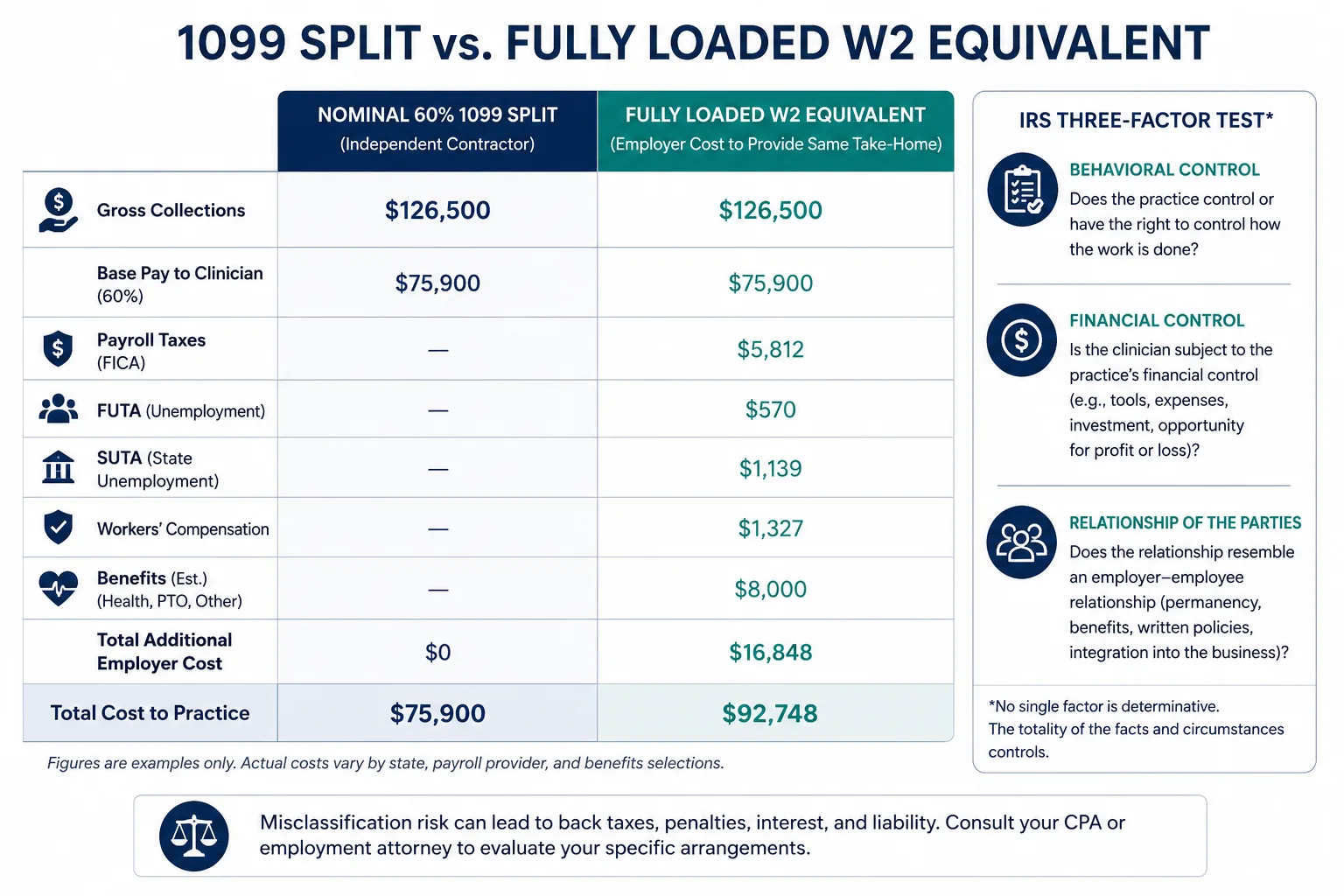
The IRS evaluates worker classification through three common-law categories: behavioral control, financial control, and the type of relationship. A practice that sets clinicians' schedules, requires its EHR and documentation standards, supplies the office, and treats the relationship as ongoing is describing employee-shaped facts, whatever the contract says. Misclassification can mean back payroll taxes and penalties, which will erase years of the margin the 1099 model appeared to add.
The financial modeling point is simpler: price the truth. A "60 percent W2 split" does not cost 60 percent. Employer payroll taxes, unemployment insurance, workers compensation, and any benefits push the loaded cost several points higher, often into the mid to high 60s. If your pro forma compares a 1099 clinician at 60 percent against a W2 clinician at 60 percent, the pro forma is wrong. Model the loaded number, then decide, ideally with an attorney on the classification question itself.
The Metrics a Behavioral Health Group Should Run By
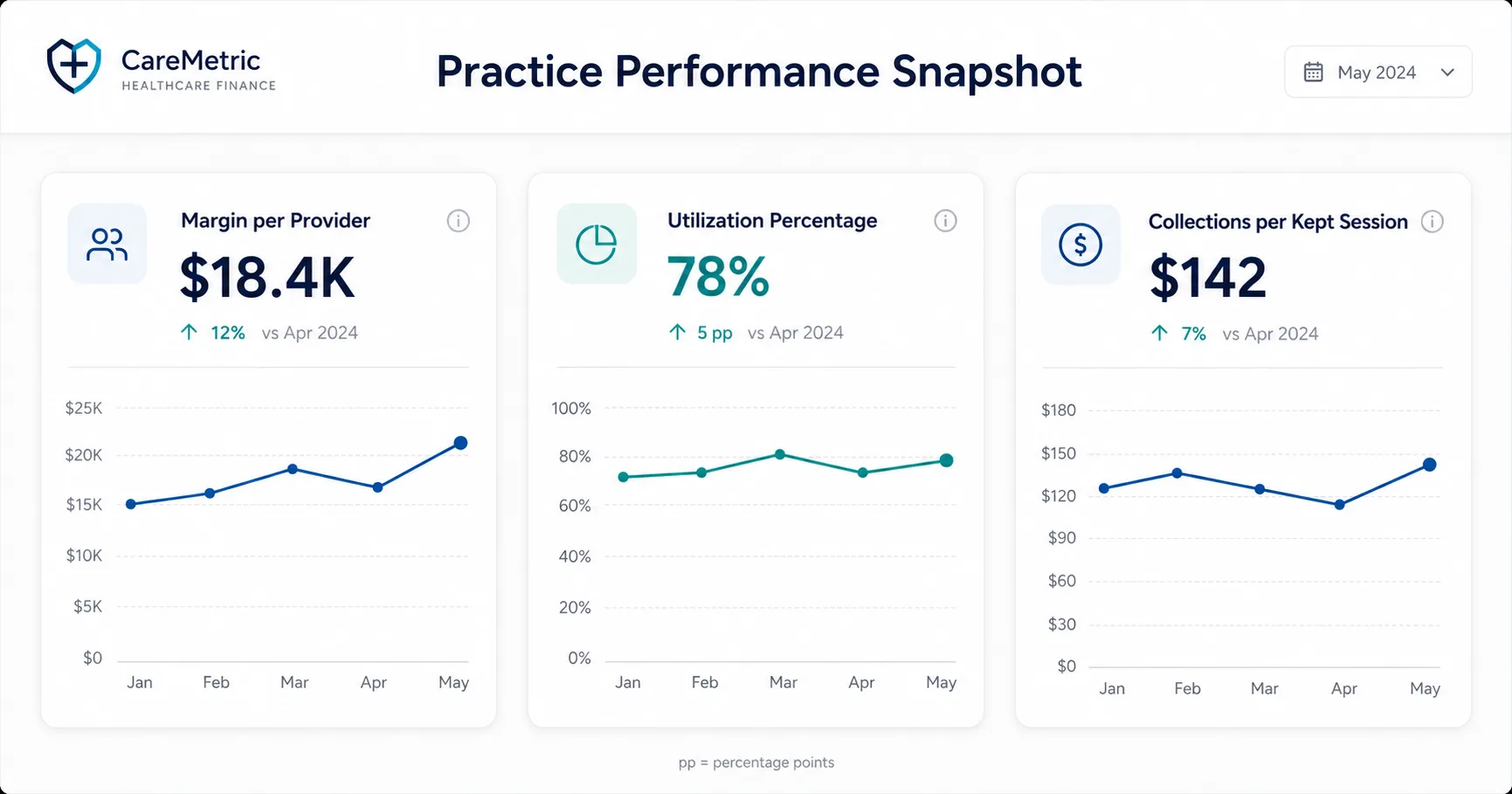
Behavioral health practice profitability is managed with three numbers, reviewed monthly. Everything else is commentary.
Margin per provider. Collections per clinician, minus their compensation, minus a fair allocation of billing, software, occupancy, and admin cost. This is the number that tells you whether the next hire builds a business or just builds payroll.
Utilization. Kept sessions divided by available clinical hours. A clinician at 60 percent utilization on a generous split is losing you money regardless of how full the waitlist looks. Track no-show and late-cancel rates separately; they are usually the cheapest margin fix in the building.
Collections per kept session. Contracted rates minus write-offs, denials, and underpayments, blended across your payer mix. Two practices with identical fee schedules can differ by $15 a session on collections discipline alone.
Producing these numbers monthly requires books that are set up for it: income tracked by clinician, overhead in consistent categories, and a close that happens on a schedule. The SBA's guidance on managing small business finances covers the baseline habits, including choosing an accounting method, and a bookkeeper who knows therapy practices can build the clinician-level layer on top. This is the same discipline that growing healthcare organizations expect from their accounting function, scaled down to a five-person group.
When Staying Solo or Referring Out Beats Hiring
Here is the part the practice-building courses skip: sometimes the highest-margin move is not growing.
A solo clinician at capacity, clearing 35 percent on a $180,000 caseload, takes home more than many owners of six-clinician groups running at 8 percent margins, and does it without payroll risk, management hours, or a second lease. If your waitlist pressure is seasonal, referring overflow to trusted colleagues, whether across town or out in DeKalb and Sycamore, preserves both your margin and your referral relationships. A waitlist is evidence of demand; it is not, by itself, evidence that you should hire.
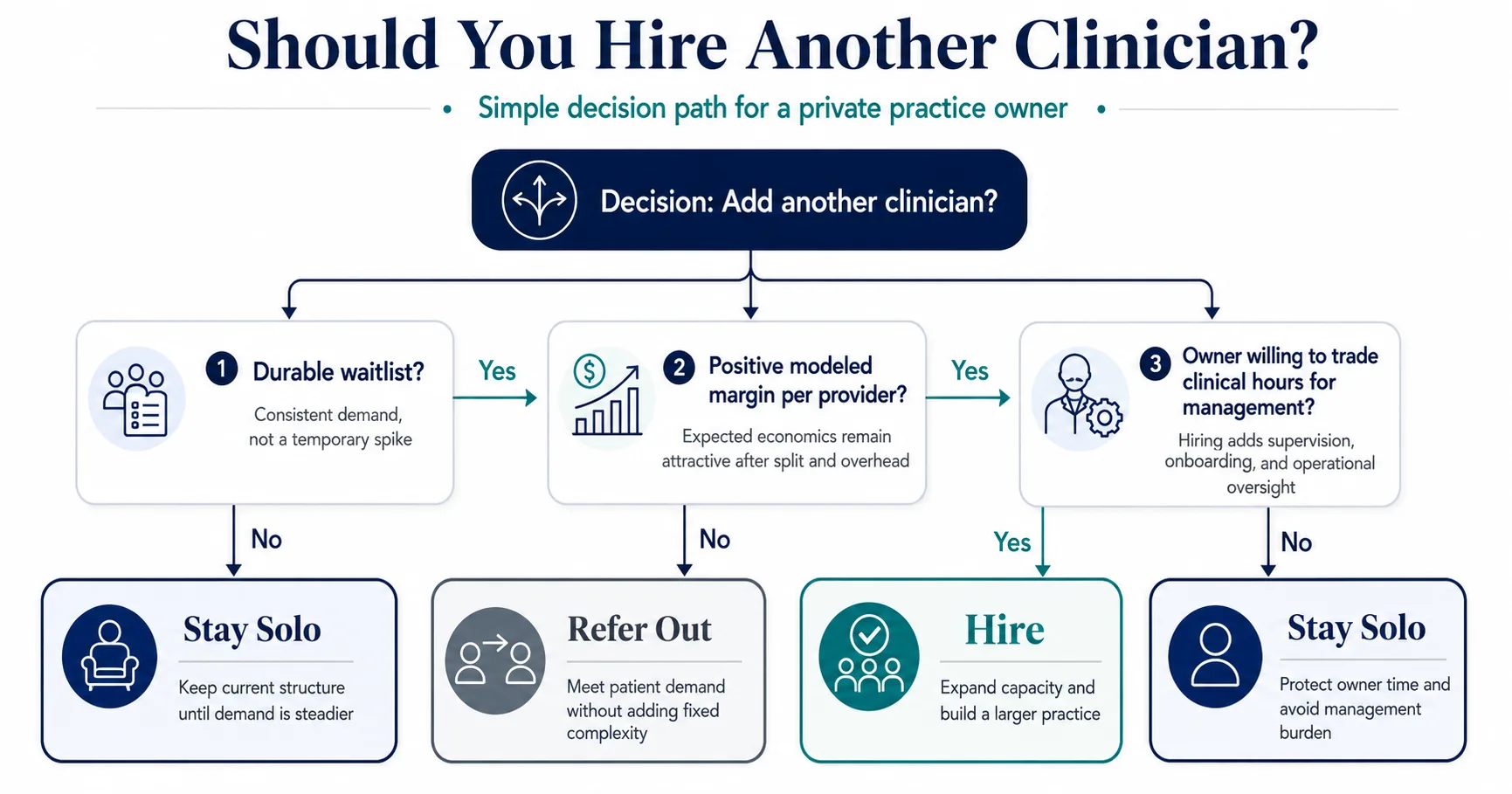
Hiring makes financial sense when specific conditions hold: the waitlist is deep and durable, the demand is in a niche you can credibly staff, the modeled margin per provider is positive after the loaded split and a fair admin allocation, and you actually want to trade clinical hours for leadership hours. That last one is the quiet deal-breaker. An owner who keeps a full caseload while "running" a group has not added a business; they have added an unpaid night job. This is exactly the stage where dedicated financial leadership starts to pay for itself, even part-time, because someone has to own the model while the owner owns the clinical work.
The Northern Illinois Market: Demand Is Not Your Problem
The demand backdrop for behavioral health is unusually strong. The Bureau of Labor Statistics projects healthcare employment to grow much faster than the average for all occupations from 2024 to 2034, with about 1.9 million openings each year, and counseling sits squarely inside that wave.
Locally, the signal is hard to miss. Rockford is a regional behavioral health hub: Rosecrance, headquartered here, operates more than 60 locations across Illinois, Iowa, and Wisconsin, and demand across Winnebago and DeKalb counties keeps climbing. For the independent counseling and therapy groups we work with in Rockford, DeKalb, and Sycamore, that is both the opportunity and the trap. Clients are findable. Clinicians are not, and large employers compete for them with benefits a small group must answer with culture, flexibility, and a split it can actually afford. In this market, the practices that struggle rarely have a demand problem. They have a margin problem, and treating it early is a smaller version of the finance transformation larger healthcare organizations are undertaking: clean books, unit-level visibility, and decisions made from numbers instead of vibes.
Final Thoughts: Grow Margin per Provider, Not Headcount
Therapy practice profit margins are not a mystery; they are a model. Solo practices earn 20 to 40 percent because one person keeps the spread. Groups compress because splits, payroll load, and an unbudgeted admin layer eat the spread, quietly and predictably. The owners who beat the pattern do three things: they price splits from math rather than habit, they classify and cost their clinicians honestly, and they review margin per provider, utilization, and collections per session every month. Do that before the fourth hire, not after the fourth lease, and a group practice becomes what it was supposed to be: a business that pays you more than your caseload did.
Serving healthcare across Northern Illinois & southern Wisconsin
Financial leadership for mid-to-large healthcare organizations across Northern Illinois
Team Consulting 360 helps multi-location medical groups, specialty networks, and health-system finance teams across Rockford, Illinois and the wider region (Loves Park, Machesney Park, Belvidere, Rockton, Roscoe, Cherry Valley, Freeport, Byron, Rochelle, DeKalb, Sycamore, Dixon, Sterling, Beloit, WI, Janesville, WI). We work throughout Winnebago, Boone, Ogle, Stephenson, DeKalb, and Lee counties, the Rock River Valley, and the southern-Wisconsin Stateline market. Growing healthcare organizations across Northern Illinois face the same payer complexity, denial pressure, and multi-site reporting challenges as big-city systems, usually with leaner finance teams, which is exactly where clean, scalable, consolidated financial systems pay off fastest.
Healthcare organizations we work with
- Mid-to-large: Multi-location medical groups, specialty networks, ambulatory and health-system finance teams
- Growing: Group practices, clinics, and mid-market organizations scaling across locations
- Smaller: Single-location practices and businesses building their financial foundation
Ready to move forward?
Let's build financial systems your team can trust
Book a free, no-pressure clarity call with Team Consulting 360, or grab our free finance-transformation guide. We'll help you see where your reporting, cash flow, and financial systems stand today, and map the fastest path to clean numbers and confident decisions.
Free 30-minute call · No obligation · Real answers
Frequently Asked Questions
What is a good profit margin for a therapy practice?
How profitable is a group therapy practice per provider?
What percentage should you pay therapists in a group practice?
Should a group practice hire therapists as W2 or 1099?
Do therapists need a bookkeeper or a CPA?